
One of the last pretty trees on our morning walk held onto some of its leaves until I took a picture of it. Autumn did not shine in the mountains this year, probably because we had a dry season when the trees were thirsty. We drove on the Blue Ridge Parkway three or four weeks in a row, trying to catch the peak of the season.

On one of our jaunts, John stopped the car beside a little waterfall so that David and I could hear it gurgling. We found the sound both soothing and satisfying. Soon the Parkway will be closed for the season, so we won’t be passing such delights again until spring.

We said goodbye to the best supermarket cashier we’ve ever had. For about five years, Laurie scanned our groceries efficiently while chatting with us. It’s amazing how close you can feel when you have snippets of conversation regularly. She has taken a job where her husband works, and they are looking forward to having lunch together.

We sincerely hope we’ve said goodbye to the yellow jackets in our garden. I was stung two different times, and after each encounter, John sprayed the nest. It was hidden under a patch of Lamb’s Ears. Recently I saw lots of the critters buzzing about some evergreen bushes, so I watched them go in and out of the nest every time I was in that area. Yesterday I found a large hole where the entrance to their nest had been. It was about five inches wide, ten inches long, and at least a foot deep. The camera was in my pocket, so I took a picture of it at dusk. I called John and David to look at the photo on the monitor. They saw it and said, “Let’s go look at it!”
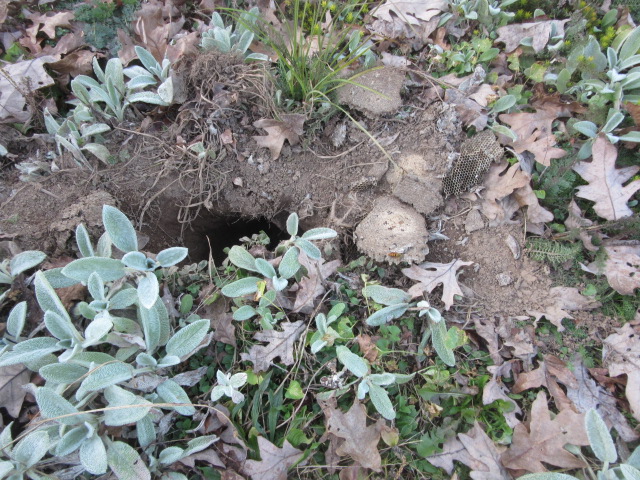
I had noticed several pieces of comb, something like honeycomb, scattered near the hole. I began to wonder if a bear had dug out the nest. I read on the internet that bears do go for yellow jackets, but they are more likely to eat them in the spring when berries are scarce. The article mentioned that raccoons and skunks prey on yellow jackets at night. They must be the culprits, or heroes, as the case may be. I saw one yellow jacket walking on the comb, and David saw a few others. They will probably be killed in a day or so when our temperatures drop sharply. We will not be sorry to see them go.
 Mehrling Muse