
Wordless Wednesday usually means a photo replaces words. The wordlessness today took place on our street. By tacit agreement, John and I do not talk until we have climbed the first hill. He has no breath to talk, and I am too busy huffing and puffing. I pulled on his sleeve to let him know a car was approaching behind us. I went to one side and he to the other. Looking back, we saw neighbor Bob grinning behind the steering wheel. He used both hands, motioning us to stay apart until he passed. I was enthusiastically waving him on, all of us laughing. As we moved back together, we saw Logan’s hand waving through the back window. It was just this year that we started the BIG WAVE when Logan is going to school. We flail both our arms wildly until he is out of sight to give him a good sendoff for the day. Silly? Oh, my! Yes! But it is harmless fun.
England 40 Years Ago — March 1, 1982
I heard a truck, a light tap of a horn, and went to look out the front window as a slip of paper came through the letter box. It was an emergency notice from the water company that water was being shut off immediately so that emergency repairs could be carried out. I ran to fill up some big pots while Kate went with the notice next door. A minute later Jennifer appeared in her apron wondering what it was all about. I thought it extremely considerate of the company to warn us. However, we never noticed any interruption of service! ?????
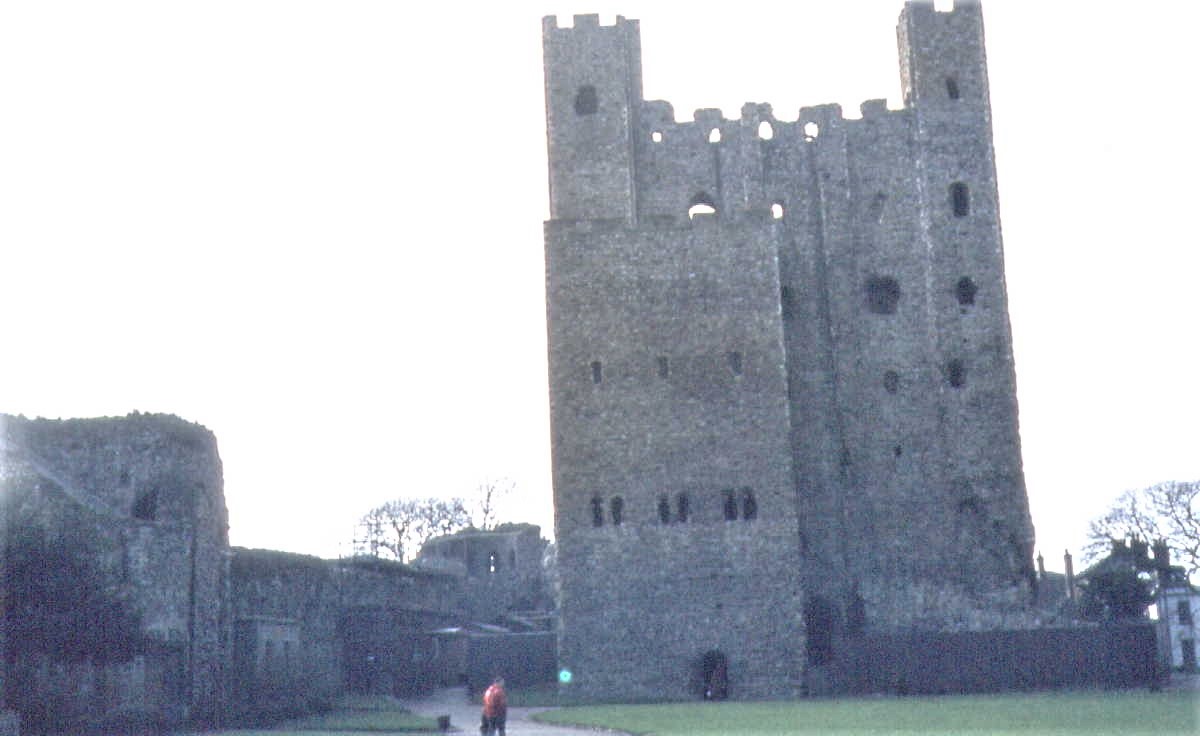
John and I took our first day trip without the girls, postponed from a fortnight ago when we spotted Kate’s chicken pox. We poked around Rochester in Kent, seeing the old cathedral and castle. For the second time we’ve seen organ pipes painted, though these were more uniform than the ones in Gloucester. I found a silver and ebony stick locked in a case that was shaped like a shepherd’s crook, but it had an odd extra piece sticking out. I wish I could have seen it better because it might have been a device for blowing out tall candles. Armin, a college friend, told us they use a blower in Germany – air blown into the tube and aimed at the flame.
The ruins of the castle are still impressive. People are allowed to climb the five or six stories on the old twisting stairs, and all the openings of windows are fenced in. What a marvelous view of the city from way up in the air!
It was good to speak to Harold, Aunt Kay, and Howard on the phone for a few minutes. For those of you who don’t know, Harold is John’s cousin who was getting married on Feb. 27.
We set out for Cardiff, Wales, in rain hoping the weather would change for the better. It did – we could see the moon and stars much of the way, but that was the last we saw of the sky for the whole trip.
Cardiff Castle, with a few Roman walls and additions from every century thereafter, is in the center of the city. We climbed up the steep hill to the round keep. The children were fascinated by all the peacocks, so John and I were left to concentrate on the history of the place.


Cardiff is noted for shopping arcades, so we dutifully walked through several. We discovered one of the crafts of this area – hand-carved lovespoons. We think a man is supposed to carve one for his sweetheart, but the stores help out those with five thumbs.
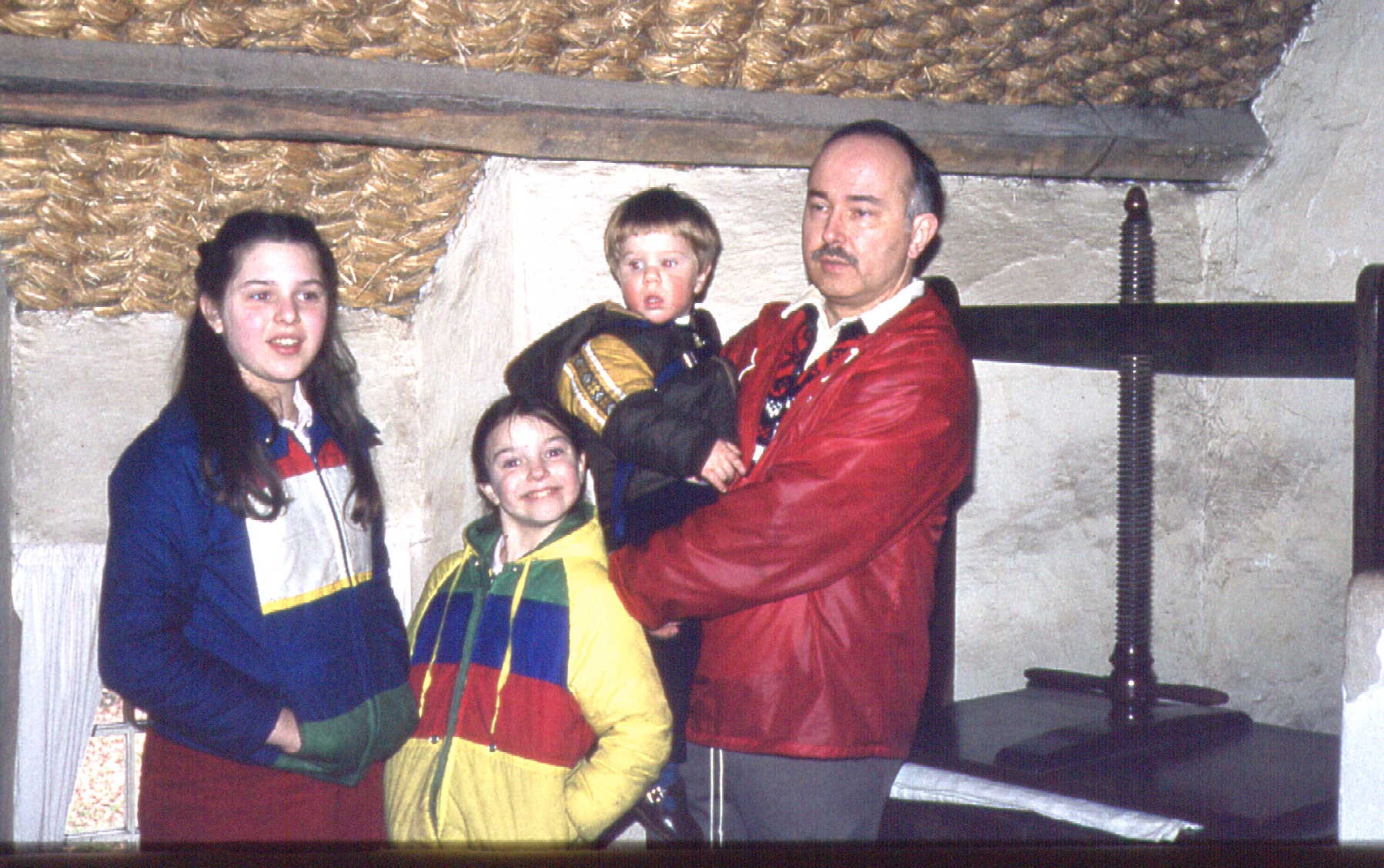
Outside Cardiff is a folk museum laid out like a little village showing Wales of the past. Cheerful log fires were burning in every house. One friendly guide invited the children to sit close to the fire, actually inside the huge chimney, and to look up to the way it narrowed at the top. We tried a picture upstairs in a thatched cottage, trying to get the lovely underside of the thatch. Even in fairly primitive houses there were grandfather clocks. We liked the beds in the more comfortable houses – a mattress completely enclosed in a large wooden box. Must have been cozy. One guide pointed to what we thought was a stone floor. “No,” he said, “It’s made of earth, manure, and blood.” That accounted for its red colour.


We drove into the Welsh mountains, but the fog was so thick we could only see the side of the road. My impression of Wales is of green and grey – lush green grass, grey sky, grey buildings, grey earth. Coal mining is the main industry in the southern part. It is a poor land, though the miners are better paid now than they used to be. We saw Aberfan. Do you remember the tragedy of 10 – 15 years ago when a slag heap buried a school, killing most of the students? We saw no scar on the landscape; grass must have covered it now.
We all laughed the next day, even Lisa. We said, “Can’t you just imagine coming into your hotel room after a pleasant evening, relaxing in bed, and then hearing someone in the thin-walled bath next to you violently vomiting? Poor Lisa had been asleep, woke in time to aim the first bit in her own bed and got the rest into the toilet. John helped her in the bathroom as I stripped off her sheets and pillowcases before the mess soaked in. Kate calmly slept through it, but $ woke up, peered over the side of his cot, and mischievously imitated the (w)retched sound.
John $ had had a coke the night of Lisa’s sickness and was wide awake after all the excitement. His father fell asleep, woke with a start when $ made a sound, leapt out of bed, grabbed the boy, ran with him into the bathroom and thrust his head in the toilet, thinking he was about to throw up. Then he stopped to look at $ – white as a sheet, shaking, and a heartbeat going a mile a minute. The poor mite was scared stiff! He hadn’t a clue as to what was happening. We must have sat holding him for an hour after that traumatic experience; he would lie back not moving a muscle, but his eyes were sprung wide open. Never did get sick!
Parts of the Welsh mountains reminded us of the moors – no trees, sparse grass, marshy land, wild ponies and sheep grazing. Across major roads are cattle grids to keep animals away from villages. The sheep had long tails, even the ones penned in and obviously belonging to someone. All other sheep we’ve seen have had their tails docked.
Sunday morning we inquired at the hotel about the time of the service in the cathedral, but no one knew. We often get to church on time, though we never know if the service is at 9, 9:30, 10, or 11. There seems to be no set custom. This time we missed; the last hymn of a crowded communion service was being sung as we walked in at 10. We stood at the back until the processional ended, and a former headmaster of a school caught us to welcome us. He knew the history of the church thoroughly and had a knack of asking questions that would catch Kate’s interest. He showed her a picture in which a man appears to have six toes, a mouse carved in the underside of a kneeler, a squirrel in King David’s family tree, a stone carving of a pelican, and a peep hole from a side chapel to the altar of the lady chapel. He held us spellbound with the tale behind the six female angels and their placement in the church. Several times he made “witnessing” statements – if only all churches had such men alert on the front line!
The cathedral for Cardiff is called Llandaff Cathedral. The double “l” has a guttural sound, almost like “cl”.
On our way home, we went to Hereford to see the cathedral there. That church is very open; John spotted repairs in the marble floor where a choir screen once stood. In so many churches the screen obscures the altar and the whole front of the church.

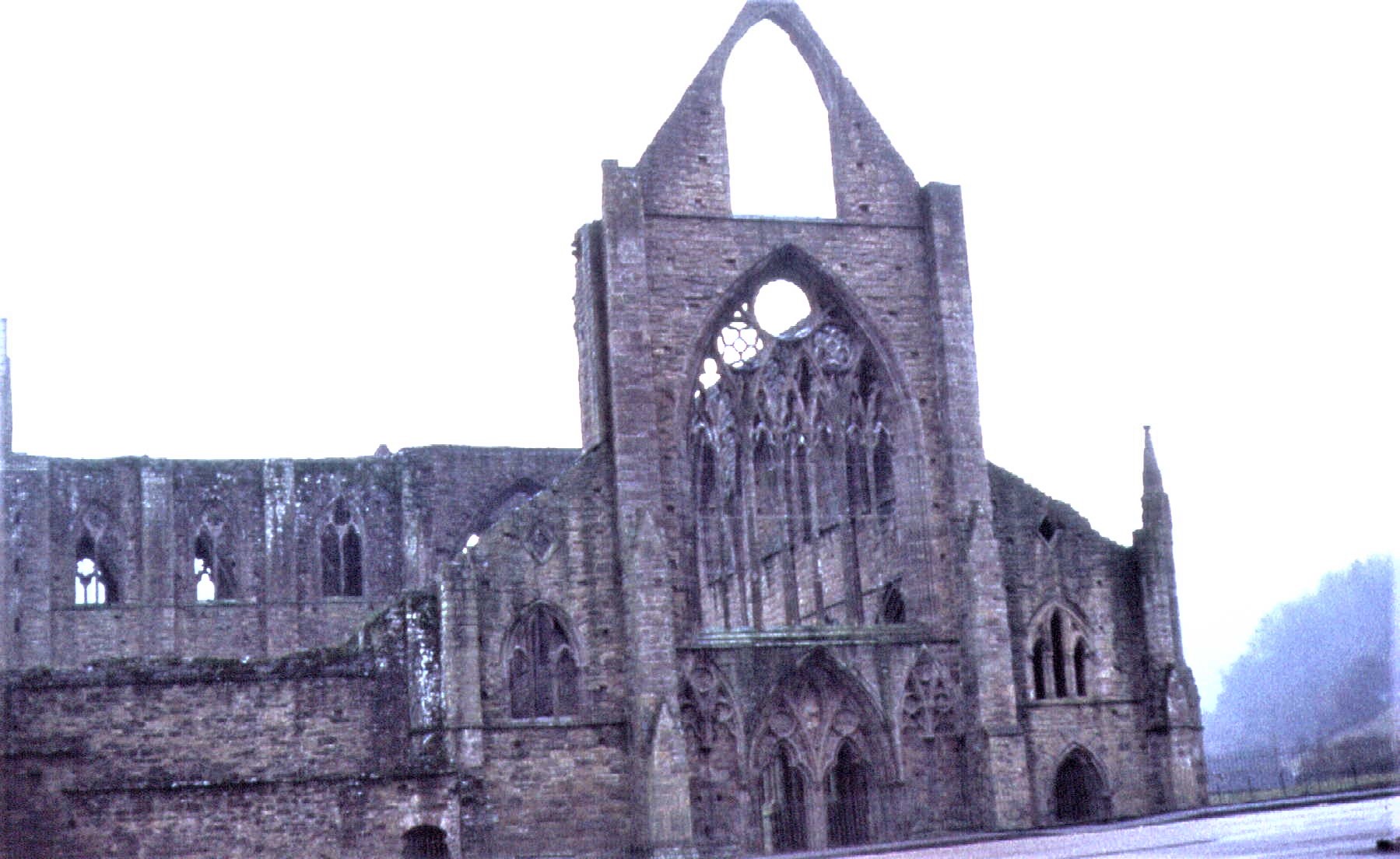
We drove around Caerphilly castle, second in size only to Windsor, though it’s crumbling. We also saw the beautiful ruins of Tintern Abbey. The weather was against us most of the trip, but we had a good time. The hotel we stayed in two nights really has good ideas for family travel. We got a special rate for staying two nights at the weekend, and the price included breakfast for all and a three-course dinner for two adults. We paid one pound extra per night per child for the room and paid for their meals. They had a choice of things from a kiddie’s menu or anything from the regular menu at half price! It was not a costly holiday.

Back at home, I was measuring milk for pancakes when movement from the back garden caught my eye. It was a fox! It had a pointed muzzle, dainty legs, red fur, and a paint brush tail dipped in white paint. Beautiful.
England 40 Years Ago — February 23, 1982, Part 2
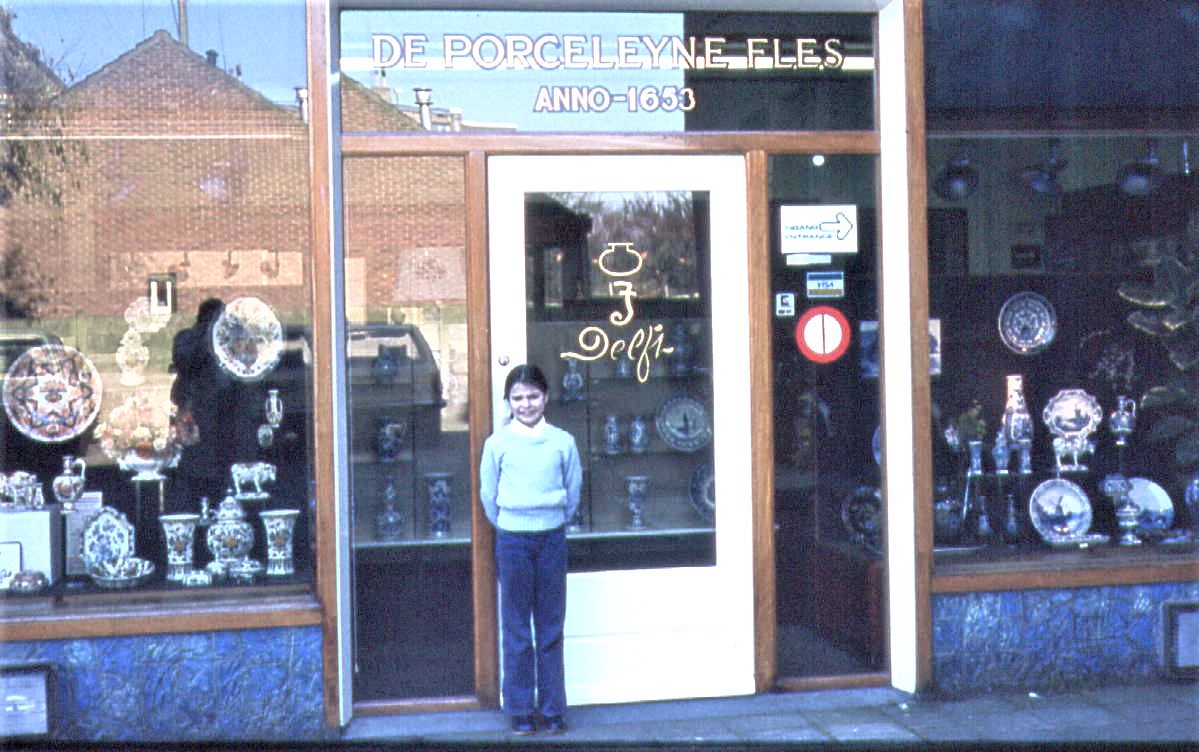
We found the town of Delft with no problem, but would have missed the porcelain factory without Lisa’s sharp eyes. Most prices on the items for sale were not visible as we walked through the showrooms. There were pictures showing how the greenware was made, and two live artists in the middle of a room painting the blue designs by hand. Actually, the paint appears black and turns blue after firing. The artists did have a rough charcoal-looking pattern on the plates and a finished plate propped in front of them to which they constantly referred. After seeing that, we understood why each piece is so expensive. A guidebook explained the trademark – a pot with a line over it, a stylized letter “f” and the word “Delft” are on all the authentic pieces.

We had been along lonely stretches at noon and couldn’t find a cafe. At some teeny weeny town we ducked in a tiny grocery. There were as many fresh fruits as in Co-op and a cheese section as big as the old Cheese Shed in Stony Brook. I’d wager we were the first Americans ever to set foot inside there; the three people were as helpful as could be without knowing much English at all.
We had our picnic in the car in a deserted parking lot beside a school, out for vacation. We never saw another person in the whole town.
Several places we saw young trees where you’d not expect trees – on a narrow street with hardly any pavement (English for sidewalk) and outside that school where we ate our lunch. The trees were being trained to be flat! Their branches were tied to flat triangular frames, and their trunks trussed up with wrappings. I presume they wouldn’t look so bereft with a few leaves on them.

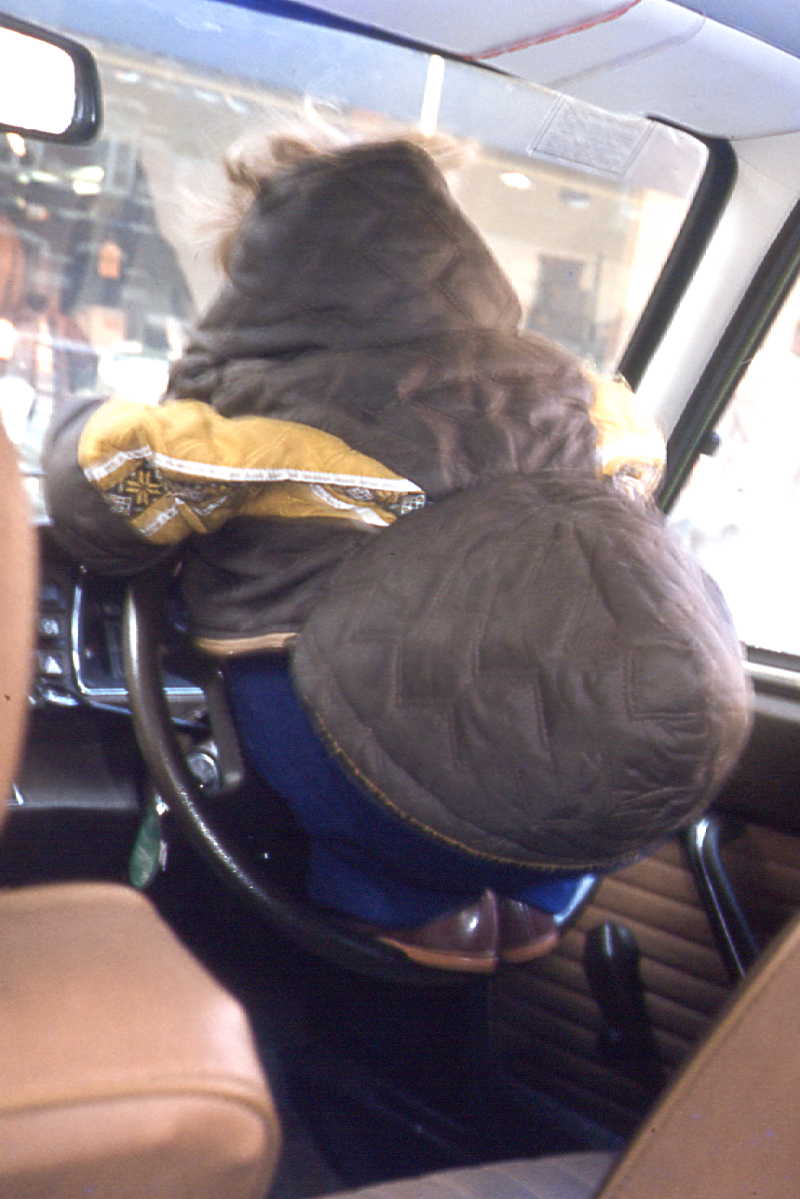
$ is good at putting on his own coat if it is laid on the floor facing the right direction. He thinks he knows how to do it all by himself, so usually gets it right half the time. The other times his hood covers his bum (English for that part of the anatomy which is used for sitting). In the car he put on his coat and played with Lisa’s swim gear. The picture he made with his coat upside down was so cute, but with the addition of a girl’s plain white swim cap worn slightly askew on the head, the effect was side-splitting. [I don’t have a photo of the side-splitter, but the one here shows $ hanging on the steering wheel with his coat upside down.]
We noticed that parents often hold a hand of their child or a handlebar of their bike as they roll along. John claims it’s to hold the mother up! Special bike lanes are everywhere, city and country alike. Hardly five minutes could go by without having a bike in sight.
We saw two Dutch ladies coming from a supermarket dressed in a national costume. They had voluminous black skirts, a small print apron, colourful shawls, and white lace caps. Their caps fit close to the head, though we understand in the area of Volendam and Marken caps have gull-like wings. The ladies we saw also had a hair-do to go with their dress, a big roll of hair atop their faces. We wondered how they kept it up; it looked as if there was a giant sausage roller inside. [I was trying to take the picture where they could not see me.]

We were tired and hungry by the time we arrived in Ghent, so we were thankful to get a hotel room in our favorite chain. It was the last room available and had one drawback – no curtain over the hugest picture window I’ve ever seen in a hotel. We were just careful to dress in the bathroom and scurried around in darkness like mice.
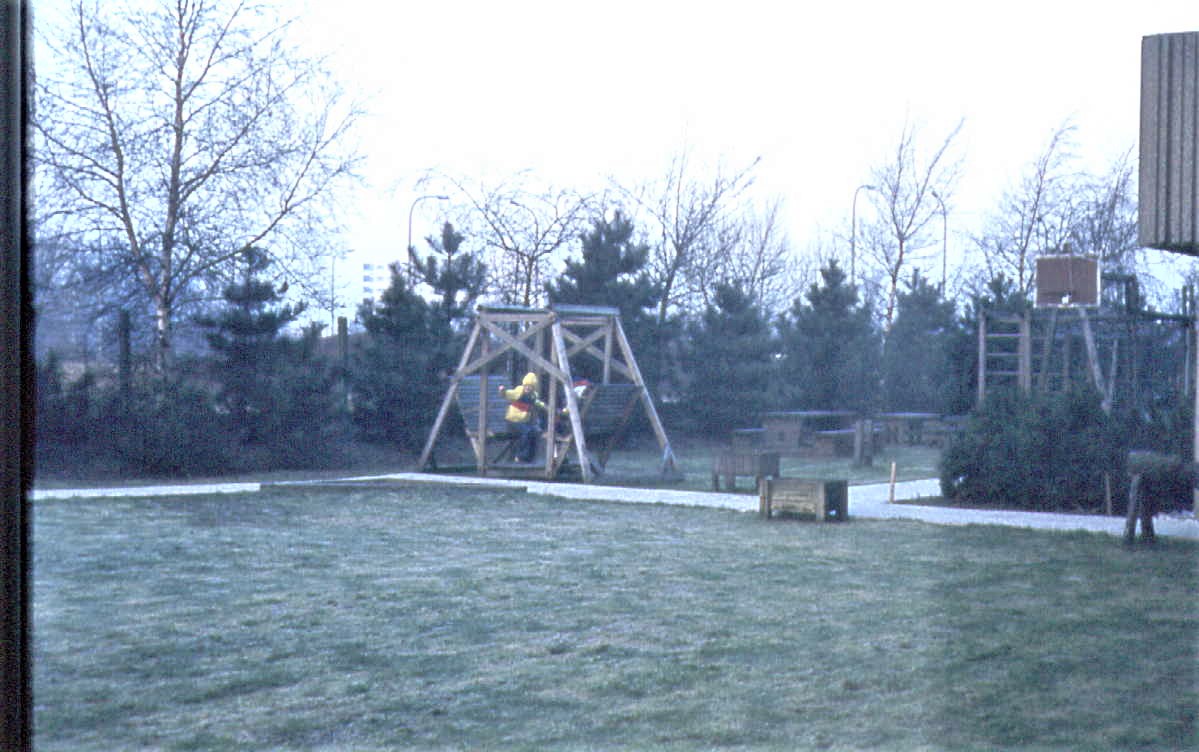
We heard the cock crow before dawn, thanks to $. He was tired of bed and climbed out. Kate and I took him to the lovely playground full of wooden equipment not far from our room, before 7:00 am! He loved the slide with a house at the top and had no trouble figuring out what to do. I was hoping the funny frozen things I could barely see were clods of grass instead of what I feared. As it became brighter, we found that it was just grass. Whew! We were certainly ready for a warm breakfast after our predawn romp.
Dutch houses that I liked:
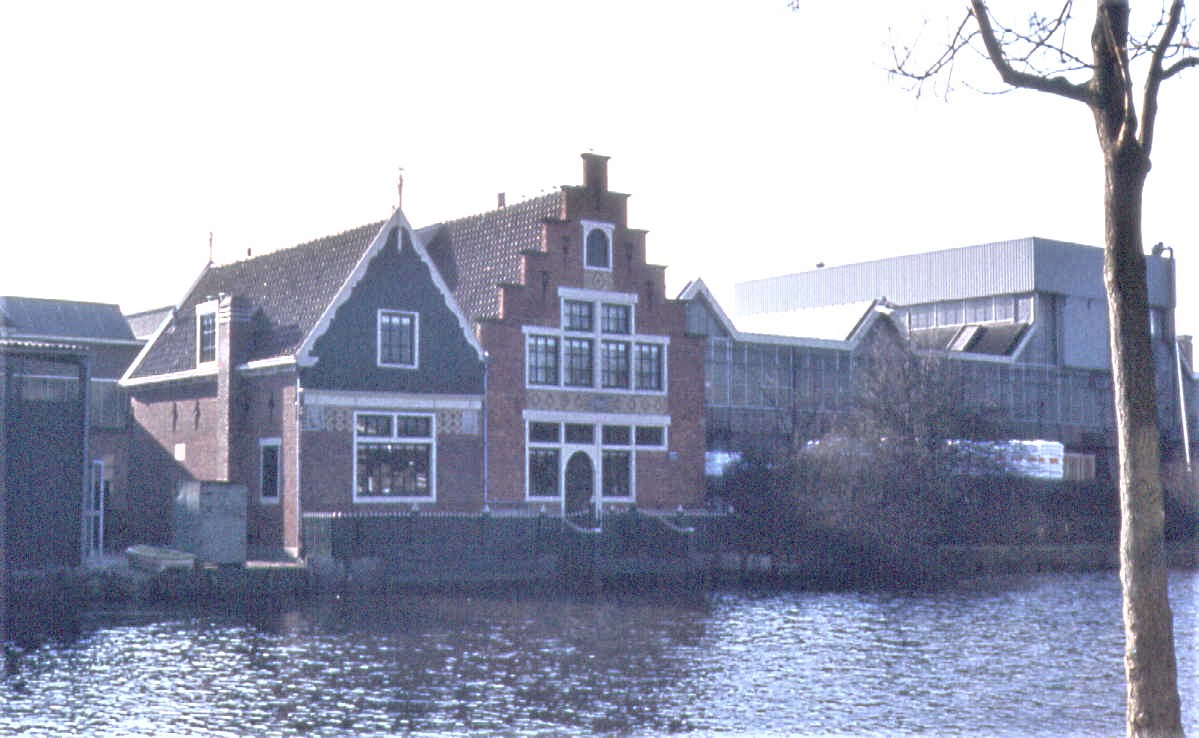
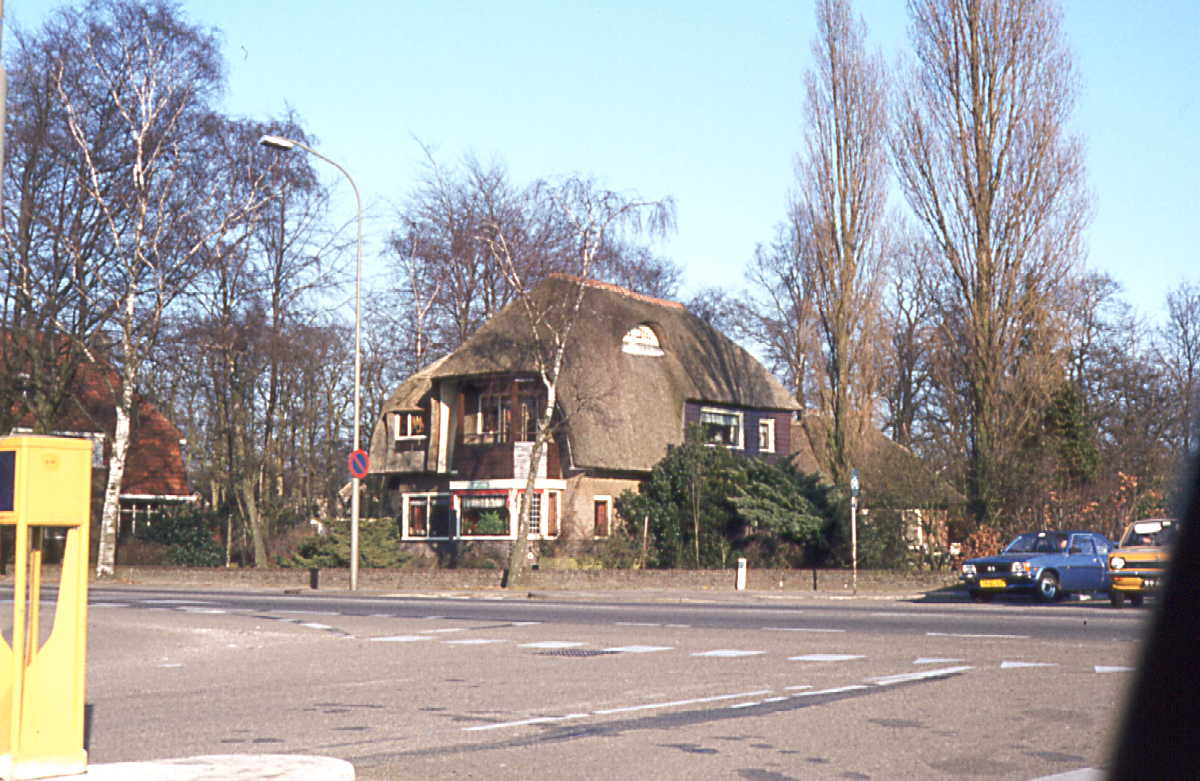

We pushed on to Calais, got an earlier boat than we’d booked, and got home at the time we should have been boarding on the other side.
After some signs I saw today, I’m simply not going to worry about all my spelling mistakes. Somewhere in the world there must be someone spelling words like I do. The sign pointing to the capital of France said, “Parijs.” Truly! We saw it several times in Belgium.
England 40 Years Ago — February 23, 1982, Part 1
What an exciting meal we had! Lisa was kindly helping serve the plates with spaghetti and a juicy dark red meat and tomato sauce. We always serve $’s plate first and often put it in the freezer to cool a few minutes. She did that, took two plates over to our table, and when serving her father, discovered the momentum peculiar to moist spaghetti on a moist plate. It quietly slithered over the side of the plate, onto the table, and down in a red splat on the green carpet. John nimbly leapt aside, ran for a spatula to rake it up, and began cleaning as I opened the freezer door for $’s plate. Splat! The plate evidently slid to rest against the door when Lisa closed it and naturally exploded onto the floor. Kate shared with John, I shared with $, and we ate happily ever after. The moral is: the family that messes together mucks together.
Did you know that English people don’t have odds and ends? It isn’t that they are neater than we, but they have “bits and pieces”. They also have “odds and sods”, various things of little importance.
Also, though I’ve read of chain stores here, it can just as well be “multiple stores”. I guess that’s all right unless they abbreviate it to MS. Paula (friend I met as a cashier at the supermarket) had never heard of multiple stores. Perhaps it’s something written, not spoken, or it comes from a different section of the country.
The butcher said, “here I am standing like a lemon.” These things are easier said than explained! Roughly it means you’re in a hurry, but momentarily pause because you can’t think what to do next.
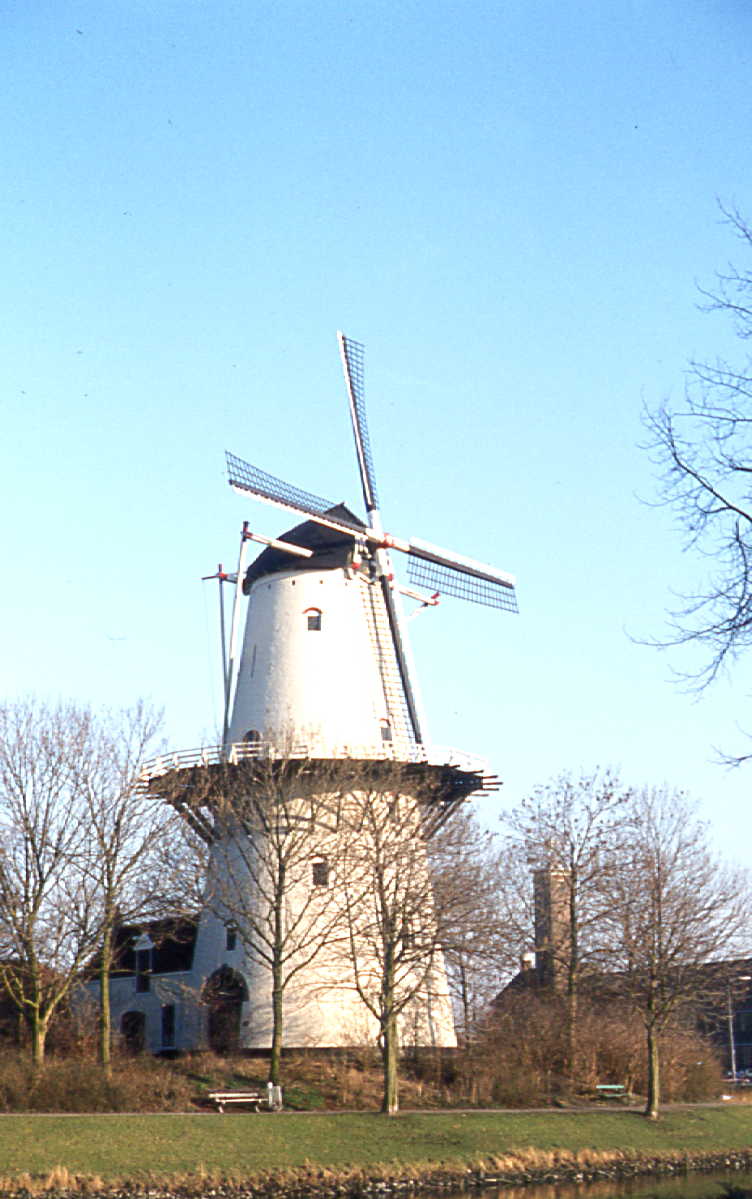
We left for the Netherlands Friday morning and returned today, Tuesday. Windmills are not dead! We must have seen at least 10 on the drive up to Amsterdam, one of which had sails and was actually working. This was an exciting drive for $ who recognizes and calls by name trains, tracks, water, windmills, cows, sheep, horses, boats, and trucks.


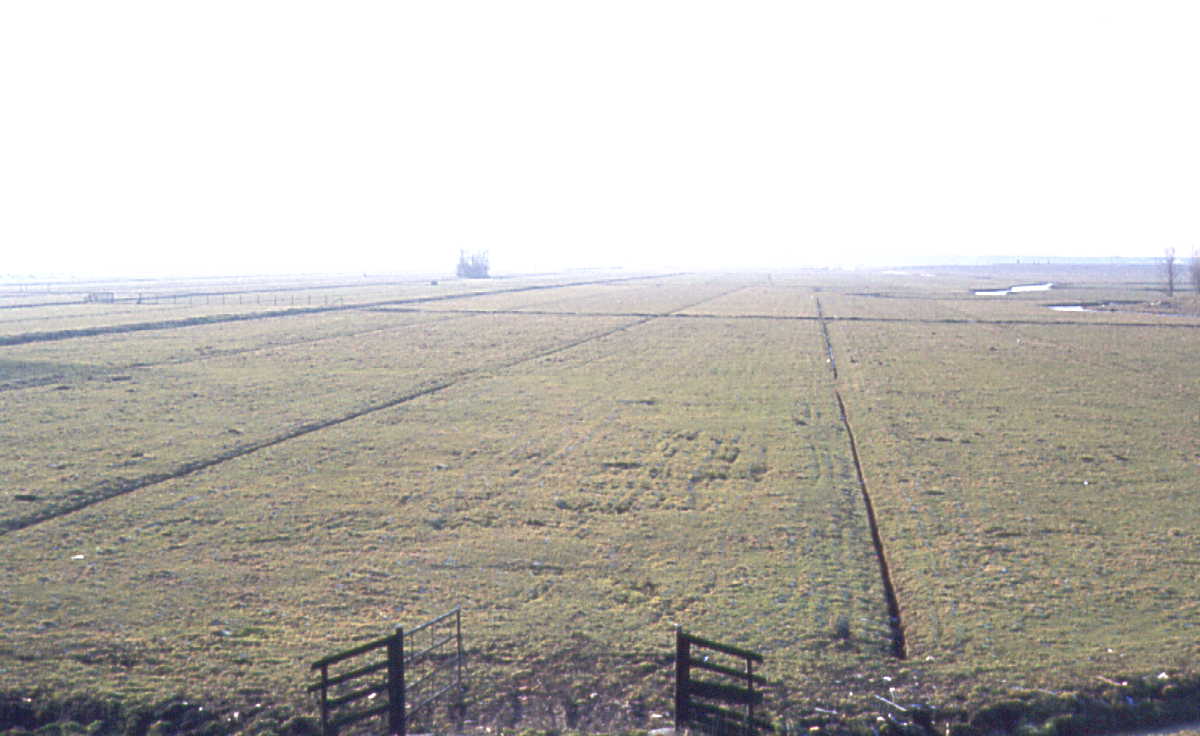
I knew this country was rich in canals, but I had no idea it was branded by grids of ditches. Open fields beside the highway had small ditches (less than one foot wide) every 50 – 75 feet and three-foot wide waterways after every three or four small ditches.
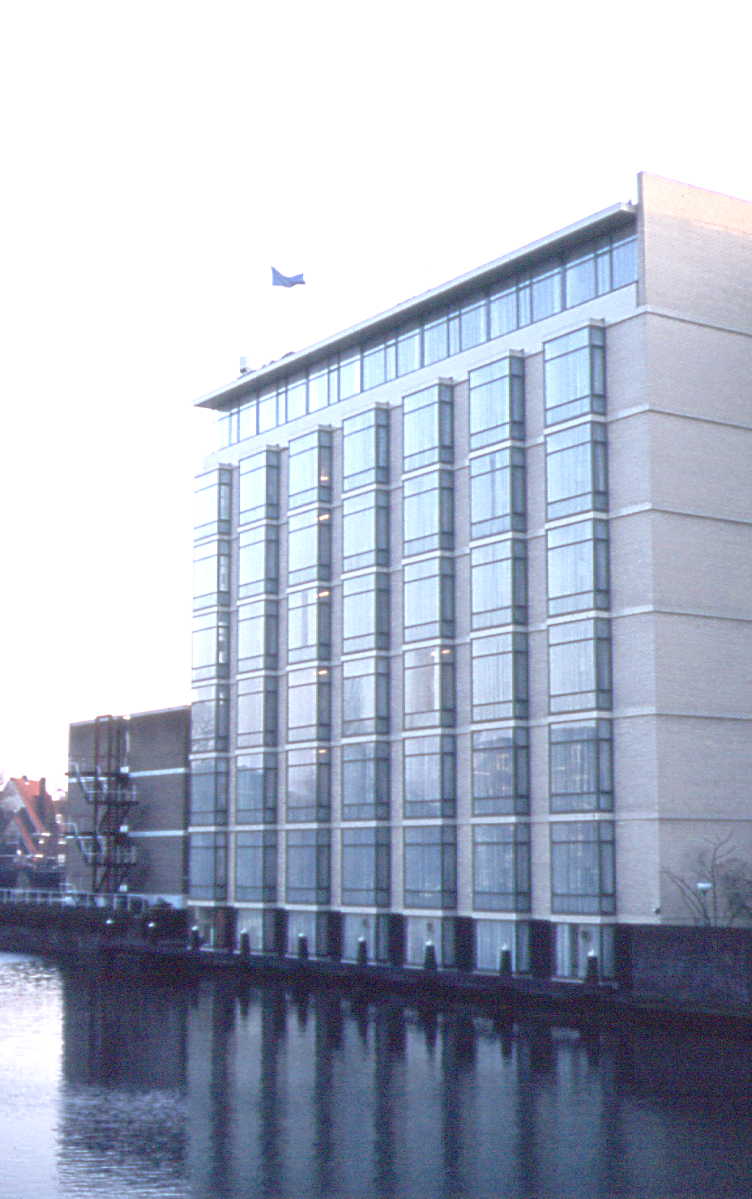
Our luxurious hotel overlooked the junction of five canals. There seems to be more traffic in waterfowl than boats in the winter.
Our first morning in Amsterdam began like no other – John called an American in London as arranged and took a new job! He’d been interviewed on Thursday, and there were a few questions on both sides. He is supposed to start work May 1, having a chance to be with us when the girls have a month off from school. The company is downtown in Manhattan. So, we’re all headed back to New York eventually, though the children and I may stay in England for school and housing reasons for a while longer.
Amsterdam is the diamond center of the world. We walked to the van Moppes diamond shop from our hotel. To cut a one-carat diamond takes eight hours! Then it must be shaped, the facets cut, and the polishing done. We learned that a great percentage is lost in cutting, but that all dust is saved and used, mixed with olive oil, for cutting and polishing. Only diamonds are strong enough to cut diamonds.
Our little Japanese guide spoke fractured English, but much of what she talked about was on signs. She and I talked quite a while after the tour, and she said though she’d lived in Holland for seven years, her Dutch was atrocious. She claimed that people who speak English will try their best to understand, but the Dutch people insist you speak their language perfectly. If she mispronounces a Dutch word, she will be told bluntly that she is not understood.
Dutch people, unlike the English, eat publicly all the time. Restaurants are open earlier than in England, and informal snack bars are everywhere. There are pastry shops, cafes, burger places, pizzarias, doughnut stores, and coffee shops galore. Not only are the eateries there, but there are always people inside snacking.
We rode the tram into the downtown area and took the hour-long canal tour of the city. When the recorder tape broke, the man in charge announced things in Dutch, English and German, and a passenger volunteered to translate to French. We were impressed with their linguistics. We found that Dutch children are required to study those four languages in school.
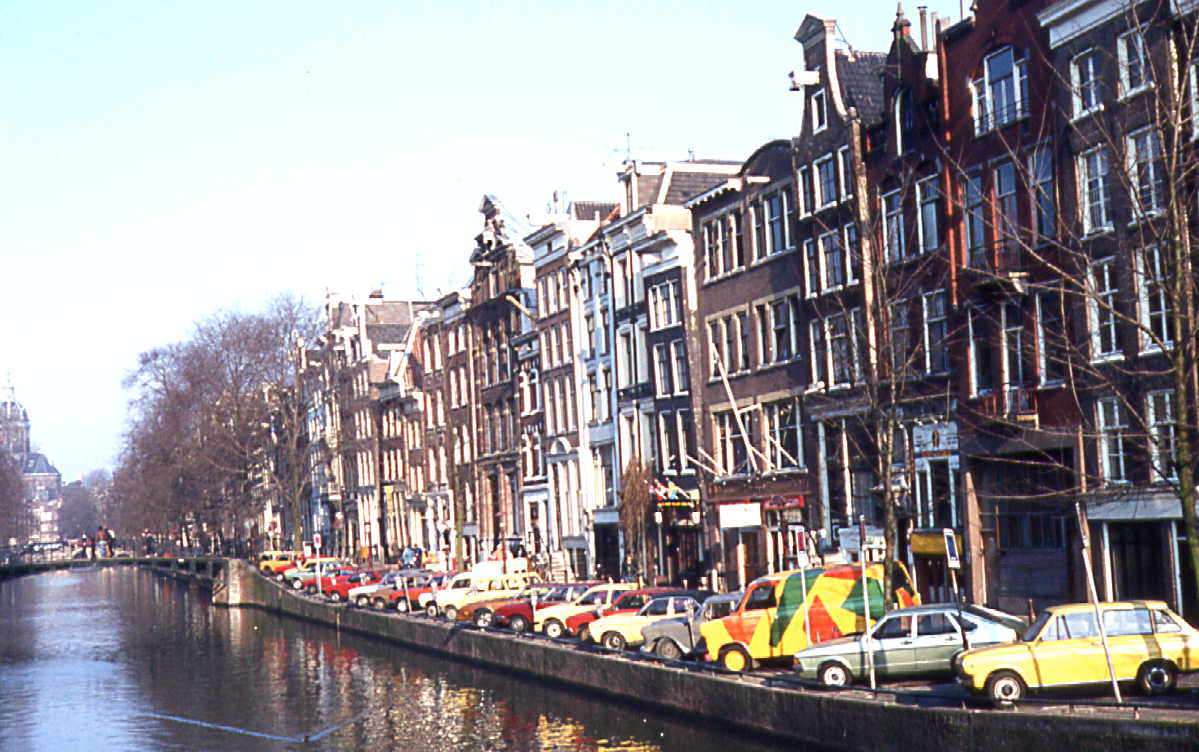
Below are photos of a bridge over a canal, a wide canal, Central Station, interesting facade of a house, and a tiny white building that is only one window wide.
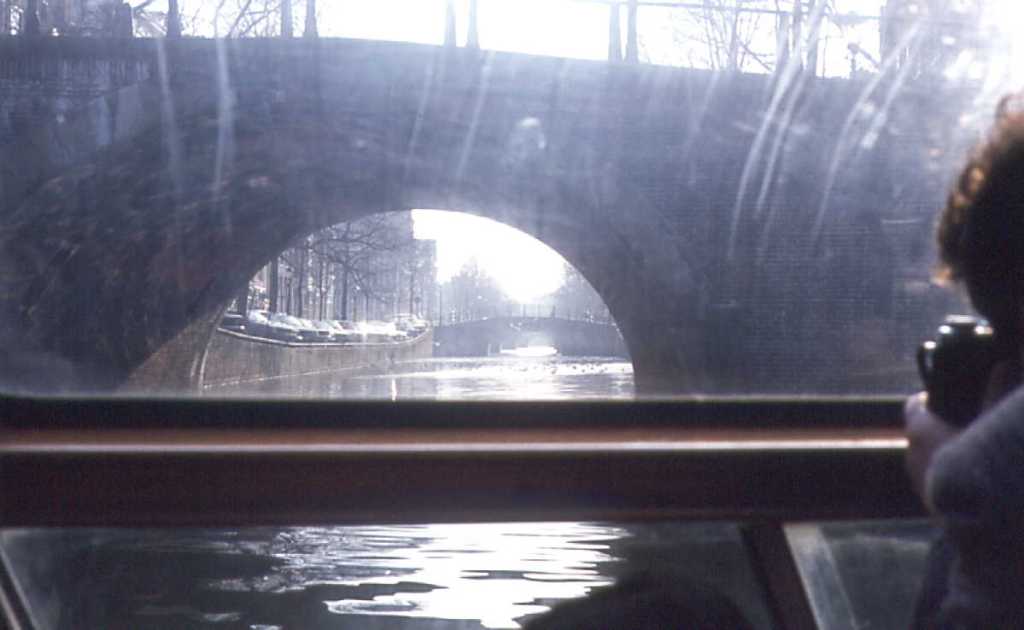
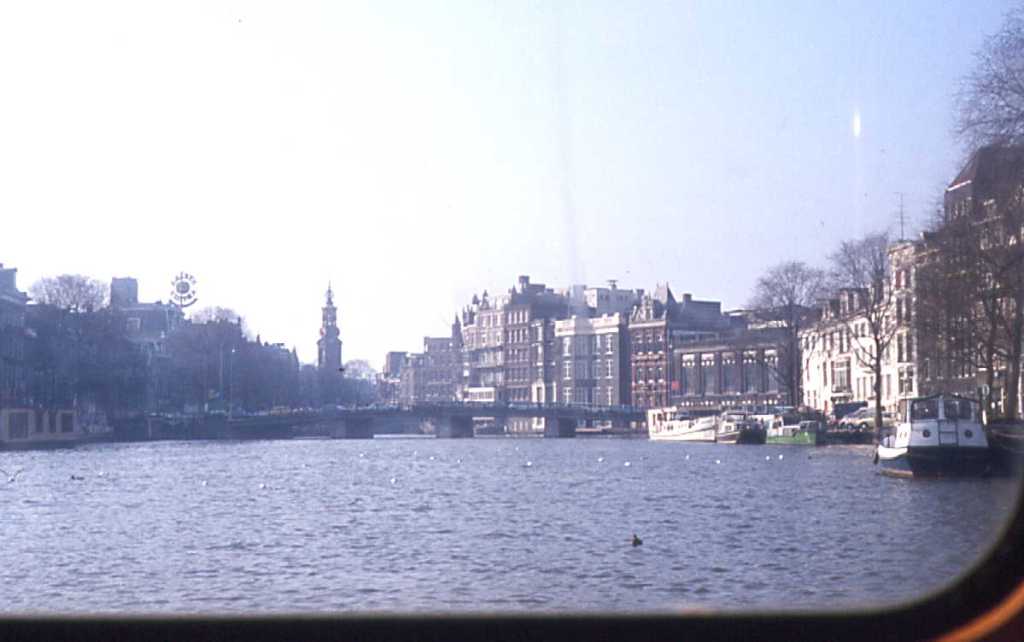
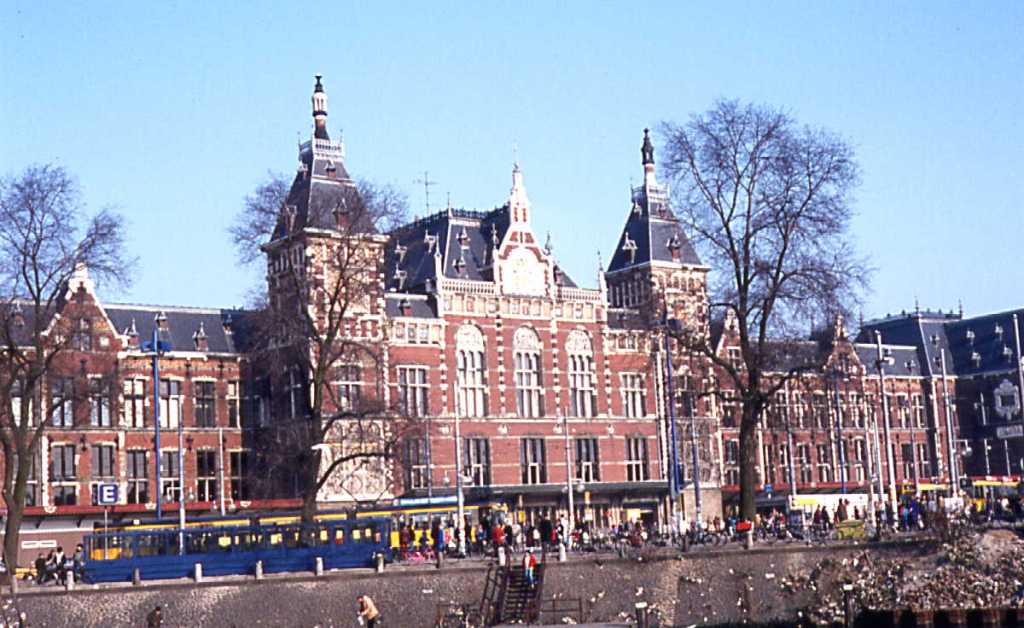

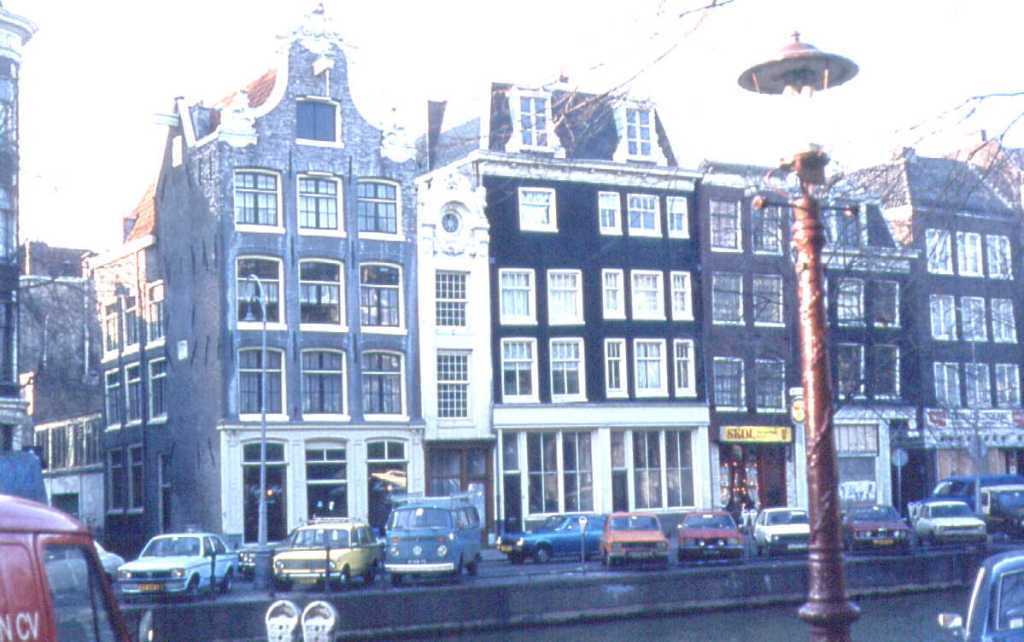
The canals do not stink, being kept flushed by the tide. Only one river is a natural waterway; all the canals are man-made. I used to feel sorry for these people having to cope with water, and now I find it is by choice in Amsterdam!
John spotted the highlight of our walking tour – movers using block and tackle from a hook at the top of a house to lift crates through the wide upper window. A majority of the buildings seem to have these hooks on beams.
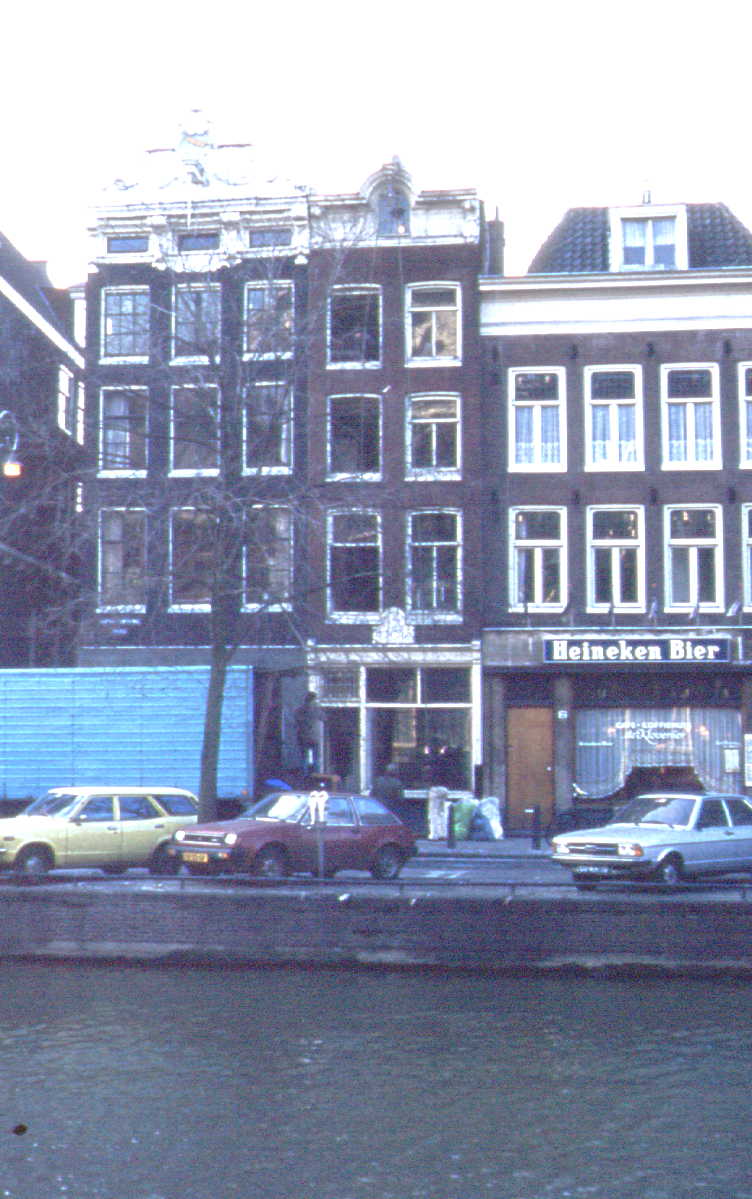
Most canals have one-way streets on both sides, and cars are parked by the squeeze method. Wherever you think a car wouldn’t fit, there is a car. A pedestrian’s life is in almost as much danger from bicycles as cars – the bikes WHIZ where the cars only speed.
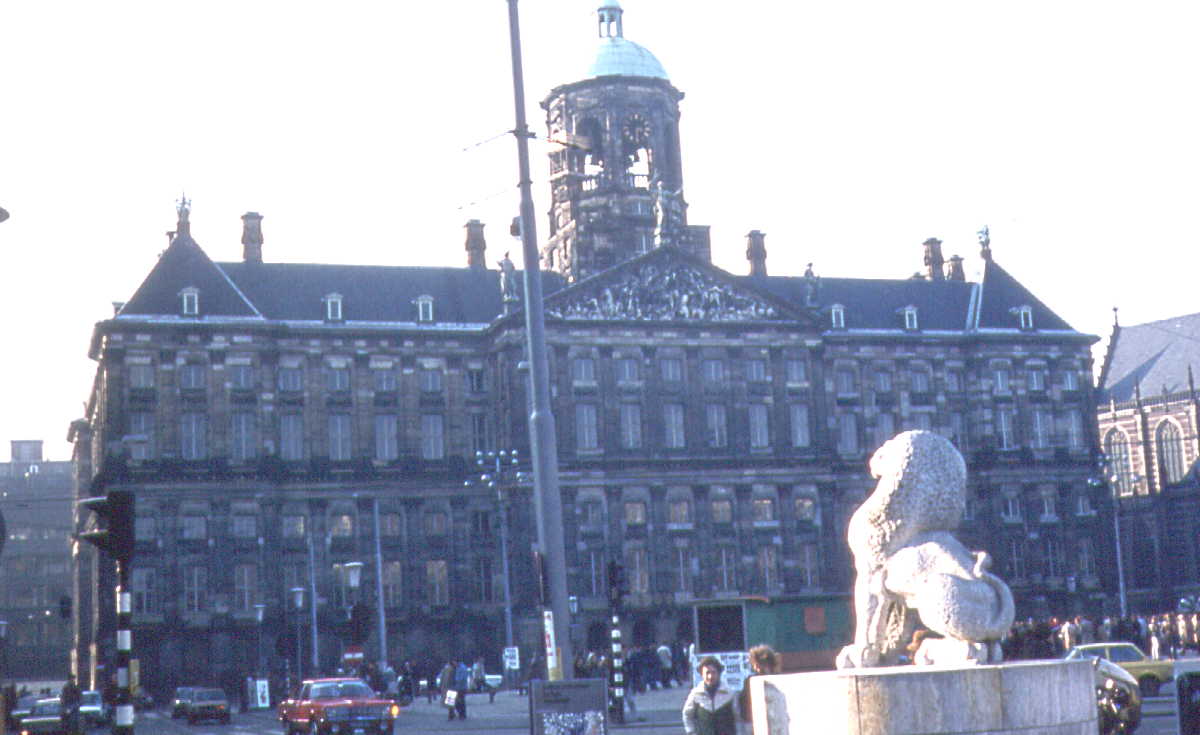
We saw the grey stone royal palace from the outside and Rembrandt’s house from the inside. R’s house is full of his etchings and has a good display showing how etchings were made. A copper plate is coated with an acid-proof layer, that layer is scratched away by the artist to expose the metal, and an acid bath eats into the exposed lines. The plate is cleaned, inked, and then printed on damp paper.

We went in one large church that made us appreciate more worshipful attitudes elsewhere. Chairs were faced toward two organs rather than the altar, social action signs were hanging from the rafters, flower prints were sold from stalls, and there were vending machines and tables set up for coffee drinkers! We were impressed with the HUGE carved wooden canopy over the pulpit. It had angels, religious figures, windows with people inside, and little people hanging over balconies. Our overall impression of church life in Holland was that few people bother. One lovely old church had been turned into a water sport place, and many of its windows were broken. Sad.
We’d read that the Dutch do not guard their privacy as the English do. On a long rambling walk after dark, we found that we could easily see into living rooms. On a cold clear night, they all looked cozy and warm.
On a clear day we drove north of Amsterdam to Volendam, built on the water. Two rows of houses were built on top of the dyke – tiny houses that we could see right through on either side of a one-way lane. The rest of the town was set down below sea level behind the dyke.


Edam, where the cheese of that name originated, was a small community built around a canal. We also poked around Hoorne before driving over the biggest dyke – the one closing off what used to be the Zeiderzee. We made a big circle around that water, driving on roads where the land on both sides was newly reclaimed and not yet productive. It was so empty – empty of plants, animals, and houses. Swinging toward Amsterdam, we were almost relieved to be among living things again.


In each country travelers like to spot local colour. Many times national quirks are hidden or minimized in larger hotels. Most places we’ve been serve croissants for breakfast from the French custom, bacon and eggs from the English, porridge from the Scots, and cold cereals for Americans. In addition to the above, in Amsterdam there were pots and pots of sprinkles – milk chocolate, dark chocolate, vari-coloured, white, white and pink mixed. I couldn’t resist asking what they were used for. The waitress in national costume replied, “The Dutch have a peculiar habit of sprinkling these things on buttered bread.” Later that day I saw shelves full of sprinkles in a tiny grocery store. Each package had a picture of a thick slice of bread with these sprinkles being poured on top of the butter.
Logan, a Breath of Fresh Air
Neighbor Logan (11) had not come over to visit us for a long time, probably because he was very busy with school and sports. I let him in, and he spotted John at the dining room table. He made a beeline to John, hesitated a moment and sat down opposite him. He knows he is always welcome to share a meal with us, but we had finished eating. When John asked how school was, Logan responded with something he knew would please John. He mentioned that they have been studying Roman emperors in history. There ensued a discussion of what period was involved, and John brought a book to the table with appropriate photos to show him. I was impressed that Logan knew where this fit into the historical time-line.
We think Logan’s sense of appropriate behavior is far above average. He waited until John paused to ask what he came over for. “Could we play checkers?”
I have a standard ritual of hiding a granola bar for Logan to find. I suggested he find that while John set up the game. It’s difficult for me to find a hiding place that is challenging. Recently he asked that I make it a little harder! When he looked all around the room several times, I told him to look waist high. Bingo! He found it.
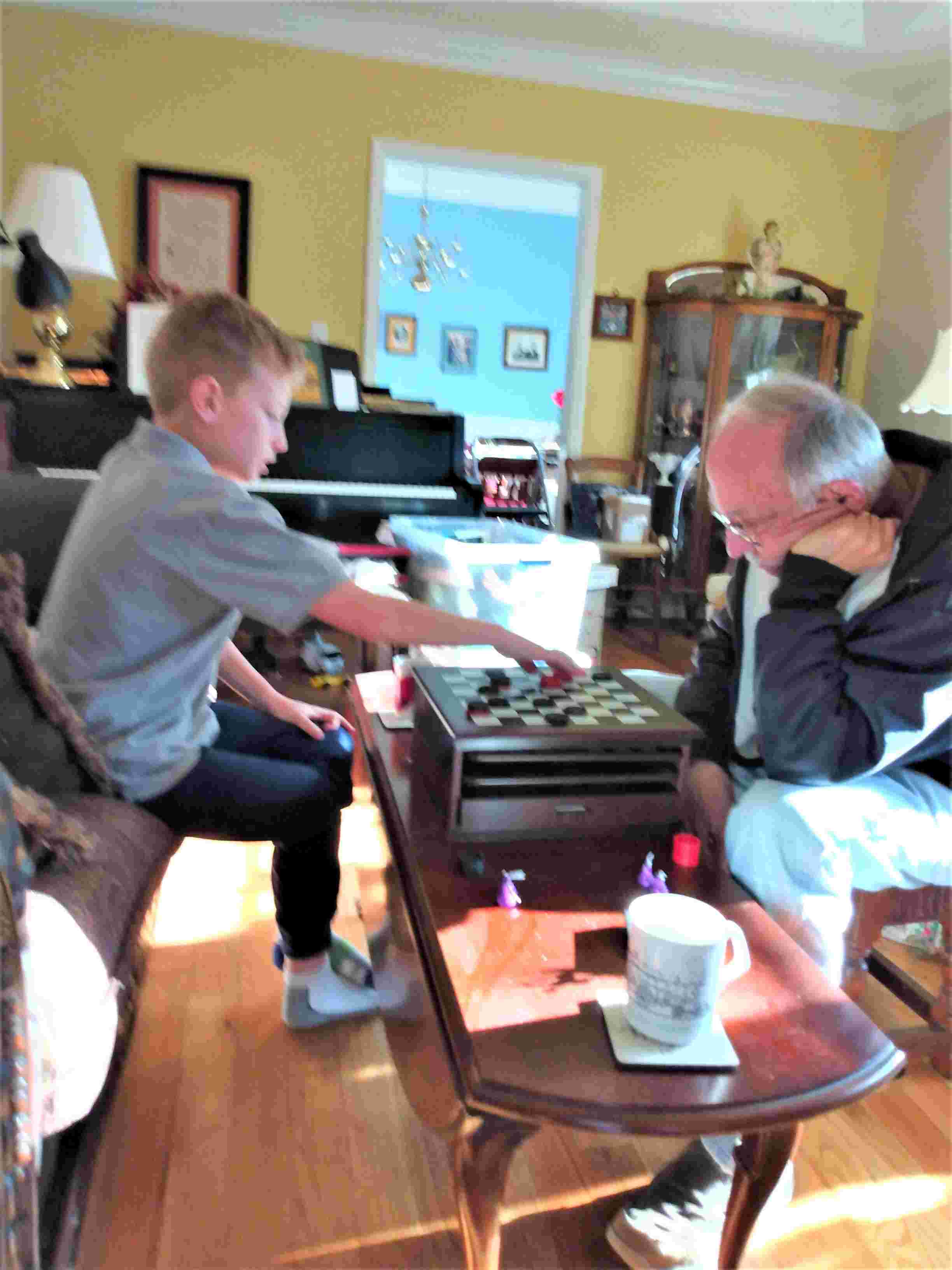
As the fellows played, I took a photo to show the concentration. They played three games until it was almost time for Logan to go home.
I was playing the day’s game of Set on my phone and showed him my time, which I think was over six minutes. I handed the phone to him, and he finished the same game in one minute and a few seconds. I am always impressed at how quickly he and David can solve those things.
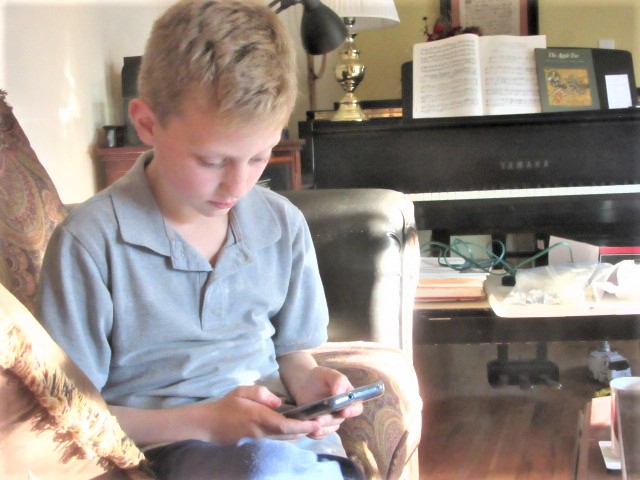
As Logan put on his shoes, he thanked us several times. His manners are superb, much better than those of many adults. Every time I notice, I silently applaud Shawn and Bob for their excellent job in training him. These skills have become natural to him and will help him in everything he does for the rest of his life.
England 40 Years Ago — February 14, 1982
You can live for years in a place and not know something is available until the crunch comes. Kate forgot to go to the bathroom in the morning, failed to take time at school, and was in dire distress when we were checking books out of the library. It would have been another 45 minutes until we’d reach home. I told myself it wouldn’t hurt to ask and was surprised when the librarian went for a key. My first thought was that it must be nice if they keep it locked. We had to go to the rear of the building, grope our way in, and find the loo. It wasn’t until we were leaving that I found the light switch. Talk about austerity – there was a light and an old toilet, no sink and no toilet paper. Kate would agree it was better than nothing.
It might not be so unusual for a 2-year-old to hand you a $10 bill, but I knew immediately that John $ had been into something! I haven’t seen a $10 bill for at least a year! I deal in pounds and pence now.
I knew something was up by the tone of John’s voice; he shouted, “Anne! I need you up here immediately.” The closer I got to the bathroom door, the more piercing the screams. Kate was almost in hysterics kneeling rigidly in the tub wailing over her spots. We immediately suspected chicken pox which none of the children have had yet. She finally trusted us enough to accept the fact she wouldn’t be an outcast of society.
The reactions of various people to Kate’s illness were amusing. The doctor laughed when I asked if she wanted to diagnose it in her surgery, on a house call or by telephone. She chose the telephone. Kate appreciates $’s actions the most: whenever I put a cooling lotion on her spots, he lifts his shirt for the same. Lisa said, “Well, you’re always wanting to do things first, and now you have.” John kindly told her we don’t need a dog for a pet because we can call her “Spot.”
She seems to be having a mild case without too many spots and not a lot of itching. According to a baby book, we should be able to take our short holiday next weekend before the other two come down with it in about a fortnight. Meanwhile, it certainly is handy having John home so that Kate doesn’t have to go with me in the car to get Lisa to and from school. (Kate doesn’t like to stay in the house by herself.)
Last night John and I left Lisa in charge when we went to dinner at the home of the fellow who took John’s job at work. Also there were the bachelor lawyer, John G, and their friend from work Udo with his wife, Tina. The last three were our Thanksgiving guests, as well. We had a great time. They have a lovely modern home tastefully furnished with fine antiques. The large dining room table was of yew. I couldn’t believe the dinner she put on the table – prawn salad, chicken in a gourmet sauce, beans, roast potatoes, sprouts, profiteroles (small cream puffs piled in a pyramid and covered with chocolate sauce), cheese, mints, and a concoction of sponge cake, meringue, whipped cream and strawberries. We found out she works full time preparing tax returns, and her busy season lasts from March to December!! The man originally comes from Lincolnshire.
The conversation I found most interesting was about au pairs. This couple have had an au pair for years since the mother works. Young girls from other countries sign up with agencies to get this work, usually being about 18 years old, and the purpose is to improve their English while seeing parts of this land. In exchange for their room, board, small amount of spending money, and one day off a week, they do light housework and mind children. Most often they come for only one year, so I presume this couple have had many over the years. The general rules are roughly the same; you can require six hours of work a day. Their present girl is from Yugoslavia, though we didn’t see her because she was out for the evening.
[There were no photos to go with this letter. These days, I think an American hostess would be pleased if someone took a picture of a fancy meal she had prepared. Wonder what the reaction would have been 40 years ago???]
What’s the Story?
As I reached the creek, I saw three items on the rock.
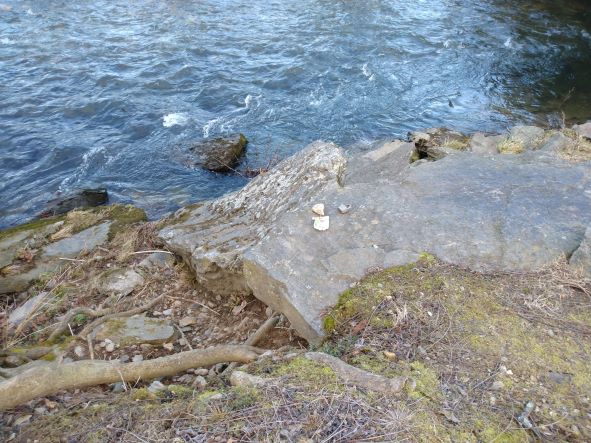
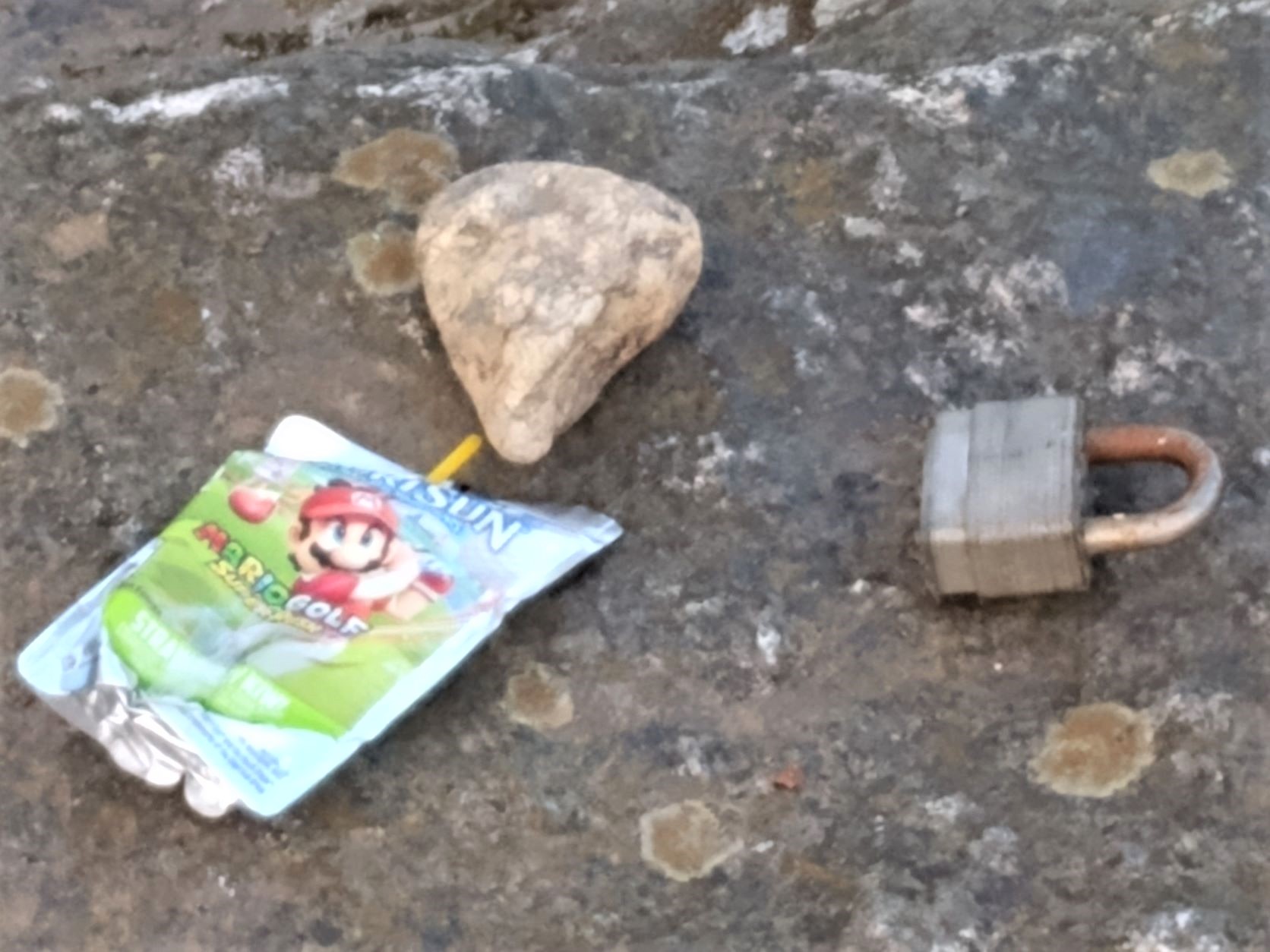
Zooming in, I took another shot and put the camera back in my pocket. All the way home, I wondered why those items were grouped together.
A woman’s story:
My darling love, I went back to “our” rock where we used to talk for hours by the creek. The gurgling water was the same, but my life has been shattered. Nothing is the same since you left. I sat there, having a pouch drink like we used to. Remember that hot summer day when we moved some big stones to change the music of the stream? They have been scattered. I looked at my feet on this cold day and discovered a heart-shaped rock, worn smooth by the flowing water. Picking it up, I warmed it in my hands as if it were your heart I was massaging. If only I could warm your feelings for me again! I went back to the car and got the lock we found the last day we were here. I took it as a symbol that our lives were going to be locked together forever. I’m leaving a message for you, just in case you come back like I did. The rock is my heart longing to be locked with yours once more. You’ll know it was me because of the drink. I still love you.
A man’s story:
While fishing, I saw a rock and a lock under water. Put them on a big rock. Forgot them and my drink when I left.
Sadie Goes to Washington
Sadie moved to Washington State and was very happy to be in a house with a fenced yard. Probably anything was better than being cooped up in a moving car. A few days later her joy knew no bounds when Rose arrived. Rose rescued Sadie when the dog was a puppy, and their reunion was sweet.
Son John $pencer took a photo of her near the Spokane River.

I enjoyed the snow scenes where Sadie was catching snowballs thrown for her.
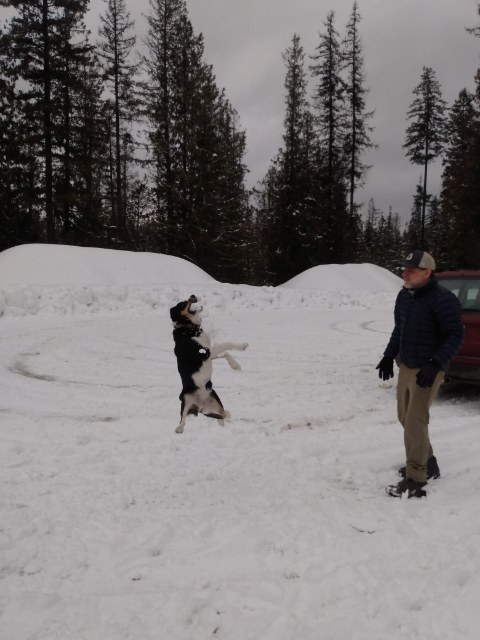


She was at peace and ready to rest a bit during a hike near the Canadian border.

England 40 Years Ago — February 7, 1982
In all my years of doing the family washing, I had the highest percentage of socks go missing one day. (In England things don’t “get lost,” they “go missing.”) By the next day I’d recovered all four.
Do you remember the verse about the little girl with a curl in the middle of her forehead? When she was bad, she was horrid. Well, little John can be haughty, but more often he’s NAUGHTY. In one day he unpacked the frozen foods all around the car, willfully threw pebbles from a planter into the fireplace, played in the salt pig, knocked down the gate at the door to play in the shower while I was washing my hair, and opened the big box where my angels were and began pulling them out. Imagine me following in the wake of that little swirling disaster, cleaning up one mess as he was making another. He had also made off with my glasses so that I couldn’t see to dress after washing my hair as the door bell was ringing. You might guess this was a day John Sr. went to London. Do you suppose he knows what’s coming and abandons ship?
John had them rolling in the aisles when he went into the office to catch up on a few things. One of the old hands in the chartering department was moving into a vice-president’s office that John had used the last two weeks. As the man pondered where to put furniture, John said, “It’s kinda like rearranging the deck chairs on the Titanic, isn’t it?” The dour Norwegian couldn’t stifle his laughter on that one.
$ decided to stir up a cake while I was fetching the girls and John was upstairs working. He used two dirty beaters, two cake testers, one clean wooden spoon, two bowls and the cheese grater. Unfortunately, the cake he stirred up was one I’d baked that morning.
We had a most delightful weekend in the Cotswolds. The first historical thing we visited was also the oldest – the foundations of a Roman villa. It was hard to believe they allowed about as much space for elaborate baths as for all the other living spaces put together. Tile mosaics were exquisite, and the hypocaust heating system running under all the floors is more advanced than many systems in use here today!


Not far from that villa were the ruins of the Cistercian Abbey of Hailes founded in the 1200’s by a brother of Henry III. Most of the foundations and some of the walls are there, filled in with a carpet of lush green grass. Just across the lane was the parish church still standing which is older than the abbey.


Tewkesbury Abbey was our last tourist stop of the day. One of the first things we noticed was a coal heater with a little wagon of coal standing beside it. The same kind of heaters were also in Ely Cathedral north of Cambridge. The photo at left was taken at Hereford Cathedral and does not have a wagon of coal beside it.

After we’d walked around admiring the elaborate, but delicate, stone work, there was a special sung evensong service in honour of the 30th anniversary of Queen Elizabeth’s reign. The reverberation period must have been at least 5 seconds, showing off the fine tones of the choir and the oldest organ in use in this country. That organ has just been reworked and was rededicated only a couple of months ago.

For Sunday worship we sat in the choir of Gloucester Cathedral. A proud sidesman told John their choir ranks sixth or maybe even third in the country. We were sitting at the entrance to the lectern, and each time the men stood waiting to read, they smiled at $. Most unusual to us were the organ pipes over the choir screen painted in colourful scrolls and intricate patterns.
We admired the shiny floor tiles typical of this area – all in two colours. They were made by pressing a stamp into the soft clay tile, filling the indentations with lighter coloured clay, and firing them. After buying a reproduction tile in the bookshop [still on our dining room table in 2022], we went back into the choir (or quire as they spelled it on a sign) to find where that design was laid. We wandered into the cloisters, saw the chapter house where the congregation was invited for coffee, and fell into conversation with the dean of the cathedral who had preached the sermon. Around another corner of the glass and stone enclosed cloister was a sign that on that site William the Conqueror ordered the census later known as the Doomsday Book.

Two Sundays in a row we’ve been in churches with such warm friendly people – Guildford last Sunday and Gloucester this week. At both we felt such a part of the congregation that we were comfortable taking communion. Probably it helps that we know the Anglican service fairly well now. These smaller cathedrals are obviously home churches for many people; the sidesmen greet the regulars as old friends and have welcoming words for strangers. Of course, this feeling can’t extend to the tourist-mobbed big churches in London.
We couldn’t resist buying the record of Christmas music by the Gloucester choir. On reading the cover, we found that Gustav Holst was very active in that church and that Ralph Vaughn Williams was born near Gloucester, though he later lived near Dorking.
I forgot to mention that we saw the tomb of Edward II in Gloucester Cathedral. If we go to enough churches, we will have “seen” most of the kings and queens of England.

A No-mess Crisis
I thought the shower head had become really clogged with deposits from our hard water. Thank heavens I hadn’t gotten my hair wet! I shouted to John, and he found there was no running water anywhere in the house. Neighbor Bob came over immediately, and the two men checked under the house. Bob suspected the pump had failed. He was able to suggest a company to call, warning us that it could be expensive. A new pump would be bad enough, but if we needed to drill for a new source of water, we should brace ourselves.
There was no telling how long it would take for the repairmen to respond. Shawn and Bob offered us their facilities and water. What would we do without our fantastic neighbors? David and John filled four gallon milk jugs at their house, as well as two five-gallon containers. The jugs went to the kitchen counter, and the big containers to bathrooms. In the photo, you can see the big water holder. Can you also see the small plastic container on the floor? That was for dipping water to pour into the toilet or for washing hands in the sink.

Two men came within six hours! The pump was at fault, and they installed a new one before dark. We had water again!! We could use it, even though we needed a new bladder for the pressure tank. They had already used the one they keep on the truck, so they returned the next morning to finish the job.
The photo shows the well cover near our driveway, with the tire marks from the large truck. We are very thankful we got off as lightly as we did.

The well cover is supposed to look like a large rock. After I added this photo, I’ve decided it looks like a friendly little alien. Does anyone have a name to suggest?
 Mehrling Muse