A Most Exciting Day for David!

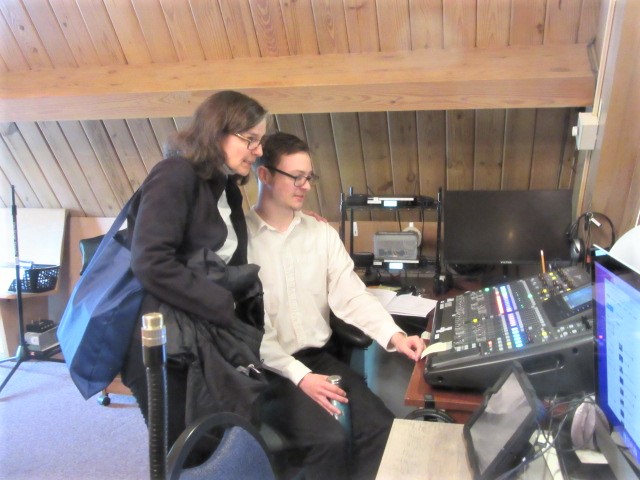
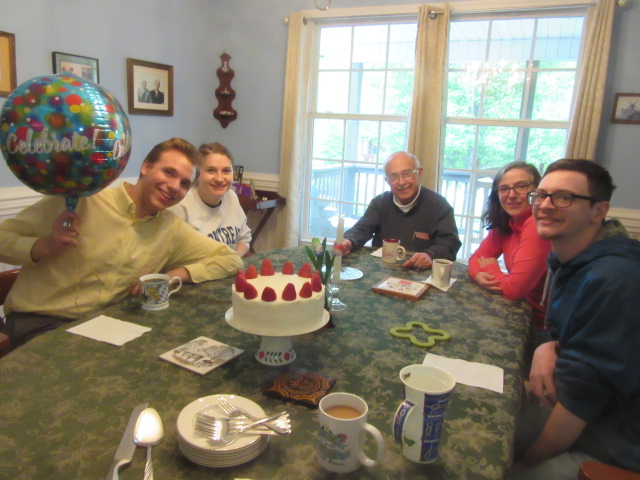
Grandson David knew his day off would be different, because he was slated to run the sound board for the Lenten service. He’d had general instructions and observed a time or so, but there is nothing like sitting in the command seat! He said he made one mistake, but no one in the congregation noticed.

Amy, the music director, was in the choir loft and thought to take a photo and send it to John and David. Wasn’t that thoughtful? I particularly appreciated it.
Earlier in the day we went with David to the Subaru dealer in Asheville, as he began looking for a car to buy. There was nothing that interested him, but he had begun the process. As we drove home, the salesman texted him, asking if he might be interested in a new car that was due to come in soon. David said yes. We hadn’t been home long when word came that the car was delivered and was there on the lot. The fellows went back, planning to see the car and wait for the church service to begin. It takes about 45 minutes to get to Asheville, so they wouldn’t come back home.

David texted me, and I’m sure if there had been wires involved, they would have sizzled. He test drove the car and agreed to buy it!!! On that high, he rushed to church and ran the sound board. His concentration must be superb.

Back of the cashier’s check

Normally he is on a very late schedule, but David got up quite early to go to the bank. His face was all smiles as he held up the cashier’s check.

Next stop was for insurance. His grin was even broader when he knew the car was insured.

At the dealership, he signed papers in the showroom while the car was cleaned and gassed up. After choosing a service agreement, the salesman sat in the car with him, showing him all the bells and whistles. David knows a lot about cars and probably didn’t learn anything new, but they went through the checklist.

They brought a sign out for him to hold, while the salesman and I took a picture. After shaking hands all around, David was left alone with his car for the first time.

I couldn’t see the screen very well in the bright sunlight, but I asked David to pose beside the car. It looks like he took it under his wing.

The last photo at the dealership shows him in the driver’s seat, ready to start the car. I leaned in and said, “Nobody is looking. Hug the steering wheel.” This was a private moment, not to be intruded upon by a camera.

We stopped for a sandwich at Culver’s. Normally David would have loved a milkshake to go, but he wouldn’t take food in the car on its first day. I have a feeling this vehicle is going to stay a lot cleaner than my old car, Snot. After lunch we drove in tandem until David turned off to go to work. I felt sorry for him, having to work a full shift after a very exciting morning.

There is one thing I failed to do. I didn’t lean in the car and get a whiff of that new car smell. I shall do that tomorrow.

England 40 Years Ago — March 16, 1982

We had a short day trip to Greenwich (don’t forget it’s “grin itch”) while the girls were in school. Climbing around the Cutty Sark was a lark – Cutty Sark, I presume you know, was not originally liquor but a clipper ship. The brass on her was gleaming – hinges, handrails, porthole rims, step guards, etc. $ enjoyed watching the hoards of little school children on their outings. The Cutty Sark is by the Thames and just a walk away from the Royal Naval College, National Maritime Museum, and the Royal Conservatory.

We walked up the steep hill to the Observatory and saw the clock built in a brick wall that proclaims Greenwich Mean Time. Its dial has 24 hours in Roman numerals; I’d know the time easily only half the time! A few feet away was a brass strip laid in concrete that is the world’s prime meridian, dividing the world into Eastern and Western hemispheres. Wow! It was like standing at the dividing point of the world!

I loved seeing all the old chronometers, astrolabes, sun dials, telescopes, and clocks. I felt if I had several years to absorb all that information, I might begin to hear the ticking of the universe. Going down a set of stairs, we could hear that peculiar music of many time pieces in symphony. To me that sound is second only to the sound of falling water. I could have listened to an hour whir away! My favorite was a big clock that said, “Cathack, thumb, whack” in definite triplet rhythm. Among the clocks were two watches that had belonged to Lord Nelson, one of which he had with him on the Victory.

Greenwich Observatory House
Queen’s House, Greenwich

At home Kate came leaping into the room to announce that her dad has lived 14,785 days.

I vaguely remember hearing that it isn’t necessary to wash a teapot after each use. It wasn’t until I questioned a really cruddy one in an antique shop that we were told this finer point of serving tea. “One should NEVER wash a teapot,” both husband and wife agreed. All that is necessary is to rinse it after each use. They claimed tea doesn’t reach a perfection of taste unless brewed in an encrusted and stained pot.

We were a little concerned at increasing evidence of recent snow as we drove from France to Luxembourg, but it was only on higher ground.

Trier, Germany, is reputed to be the most medieval of German cities. The cathedral was impressive.

Just down the street was the building that caught my fancy – the Porta Nigra – about four stories of huge stones making up a double archway, built by the Romans! In England we’ve seen flattened ruins, but this is the biggest standing Roman edifice I’ve seen. I know it wouldn’t look as big as a peanut next to the Coliseum in Rome, but when all I have to compare it with are mosaics, rubble, and a wall that’s falling down, I’ll stay impressed.

I had to grit my teeth during a long ride along the Moselle River, because I was dying to take a photo but had to hold a sleeping little boy. The vineyards on those perpendicular slopes seemed to be holding on by sheer determination. Every available bit of soil had precisely measured stakes holding the vines in place. The rows were up and down the mountainsides, often to the very top and down to the water’s edge. Cross-crossing little roads with hairpin turns provided access for cars. We drove up and up among the fields. I don’t know how people could cling there and do any work without starting a landslides of shale down the steeps (can’t call them slopes!).

We wondered why the suitcase seemed roomier; we thought perhaps we were really getting the hang of packing for traveling. No, there was a bit missing. I’ll leave it to your imagination as to whether $ mischievously took it, or I maliciously removed it, or John was too busy thinking of others to take time for himself. In any case, John C. was without a change of underwear. Somehow he didn’t appreciate it when I offered to share with him.

Though we carefully parked the car under the hotel in Trier, she refused to start the next morning. You can imagine our dismay early on a Sunday morning. A young man from the restaurant helped push the car, took John to a service station to borrow jumper cables, and used his own car to boost ours. Further disappointment – no go. As the man was about to drive off, John tried our car one more time, and she started. Relief! We had no trouble the following night, even though the car was parked in an exposed place.

Again, on higher ground, we found snow lying on the ground, though it didn’t hinder our trip to Cologne. The cathedral there is the most massive one I’ve seen and the tallest. I’d vote it the most beautiful in Europe. Despite the fact that the city all around was leveled during the war, the church had surprisingly little damage.

John came in to read the first page of this letter, then leaned over to read as I typed. I asked him if he minded if I wrote it before he read it.

We drove along the Rhine to Bonn, peeking at the river between some houses and scads of industrial parks. Then we had a front seat view on a Rhine River trip. In all honesty, I’ll have to admit it lasted only five minutes. We were south of Bonn and looking for a way across to return to Cologne on the other side. Being among the last in the queue, we were directed to the front of the last row and had a marvelous point for looking around without budging from our seats.

We saw the towers left of the bridge at Ramagen that was bombed during the war. The towers are not standing to the left of the bridge; only the towers remain of the bridge. It would help to write things out beforehand!

Overall, some trips are better than others. This will not be remembered as an easy one for John. The last night $ marched into the room, headed straight for John’s glasses, picked them up and did a Superman job on them – snapped them right in half without even a grimace. Then at 3 a.m. John rushed to the bathroom with his innards as scrambled as this word: haarrdie.

We were early for our ferry, so ducked down a street in Calais set in a huge apartment complex to go in the international Supermarche. We’d seen people interviewed on TV because they took a ferry and a bus from England to shop there for bargains. The store was the largest I’ve ever seen – ginormous, as we’d say in British slang. One end had food, and the other clothes, appliances, and even lumber. I think there were about 50 check-out counters. Opposite the check-out were several restaurants, snack bars, patisseries, and even a place for clothes cleaning. We bought cheese at about half the price we’d pay in England. I’m sure if we’d put our minds to it, we could have spent lots of money.

England 40 Years Ago — March 8, 1982

We looked at antiques in Dorking and found that the fronts of those small shops hide amazing spaces crammed full of furniture. There were small rooms upstairs, downstairs, and in lofts. The area I’m talking about is the small street where we pointed out to some of you a plaque about the Pilgrims who sailed to America. These shops specialize in larger pieces of furniture rather than knick-knacks. I was drawn to chairs, while John kept looking at sideboards. The piece we both fell in love with was a small cabinet that camouflaged a coal bucket. The inlaid wood was exquisite, but we couldn’t think of a way to use it in the Stony Brook house.

We noticed two For Sale signs – one at the house we would have loved to buy from our first visit to London and the other at Timberly (the first house we rented). Guess I’m a little wistful.

Bjorg S came out for tea and dinner; John had known her in New York and worked with her in London. She was very kind to the children, and we had a chance for a long chat after they went to bed. Enjoyable! It was nice to have the house presentable, too! All but $ pitched in to straighten, neaten, and clean. Surely that’s a reason to resolve to have company at least once a month!

We took a last swing into Westminster Abbey. As usual, the music was glorious and the preaching atrocious. After the service John showed Kate and me where he’d walked in the cloisters during the sermon. Some of the walls are from the 1100’s. Buried behind walkways and low passages was a delightful little cloister where a merry little fountain sparked in the middle of lush green grass and flower beds. Also tucked away was a treasure room where we saw the replicas of the crown jewels that are used for rehearsals of coronations, funeral effigies surprisingly life-like, the oldest saddle (for a horse) in Europe, seals and signatures of historical greats, and the coronation chair used only once to augment the ancient one when William and Mary were crowned simultaneously.

Responsibility for a service at St. Mary’s in Reigate rested partly on our shoulders when our home group led the service at 6:30 last night. Two ladies were in charge of the coffee, all women brought biscuits, the men helped with the offering, one of our group is a clergyman and could legally hold the communion service, Penny gave a testimony, several did readings and prayers, I accompanied the singers of our group for songs during communion, and John preached. It all went very smoothly for a surprisingly large congregation.

John could say, “Something funny happened on the way to the pulpit.” Just before the service he was checking the pulpit light when Tim, the minister of our group, was chatting with the regular vicar nearby. The vicar said to Tim in a chill, somber voice, “Just who is this John Mehrling?”

Tim, slightly taken aback, explained that John had been coming for two years. John walked over to re-introduce himself and got a very stiff reception. That would have really upset me, but John didn’t mention it until we were on our way home. He said the man had every right to be concerned about what would be preached by a stranger. It was a bit late to be concerned, I thought. We laughingly decided that every home group service will be minutely examined hereafter.

Today we bought an Edwardian umbrella stand that appealed to the whimsical and the practical in us. [It is in the entrance hall in North Carolina. We do not have a proper umbrella, only collapsible ones in tired heaps. A harness for Sadie and my fancy cane gravitated here.]

[For lack of any other appropriate photo, I will include our Welsh lovespoon. It should have been included in the letter for March 1.]

Bed Head or Windblown?

My hair got up on the wrong side of the bed, and I stopped to take a photo of it just before walking with John. As predicted, the wind was blowing. I figured my bed head wouldn’t matter. Here are the before and after photos. You can vote for a winner, but I think they are equally bad.

I got up earlier, hoping to get home before the sun blinded us. That turned out not to be a problem. We saw Logan dribbling a basketball on his porch, and he ran out to speak to us. John said, “Want to walk with us until it’s time to go to school?”

He ran back inside, emerging in moments with Shawn at the door. We waved at her and set off up the street with Logan. He began talking about songbirds, having seen a robin recently. We were impressed when he said he has a small book of North Carolina birds and identified a towhee. Way to go! I didn’t try to identify a bird until I was 40 years old, despite my mother’s life-long interest. Logan has started at age 11. We love that young man and admire his active brain.

Bob picked him up at the big bend. He waved from the back window, and we did the BIG WAVE, as usual. What a fun way to start our day!

When we returned, I wanted a photo of Joyce’s daffodils. A video seemed the best medium on a windy day. I tried to get the attention of the flowers, but they had their backs turned to me.

Shadowed

I was almost to the creek when I noticed how nice my shadow looked. The sun had just come over the mountain, making my silhouette tall and thin. I could adjust to that, even though the truth is far from it. Yes, I would identify as willowy. Just then another shadow from the church drive began to touch mine. Wait! I’m walking alone. Why is there another shadow? Turning my head, I exclaimed, “There’s another shadow! I didn’t see you.”

The man said, “I’m sorry I scared you.”

“You didn’t scare me. I was just surprised.” We wished each other a nice day, and he strode on.

He was carrying a take-out box, and he went into the trailer at the roof-framing place. I decided he had come from J Creek Cafe and was hurrying to eat breakfast before it got cold. By the sound of things, he didn’t share with his yappy dog. I’ve never seen the dog, but it barked as I crossed the road to head home.

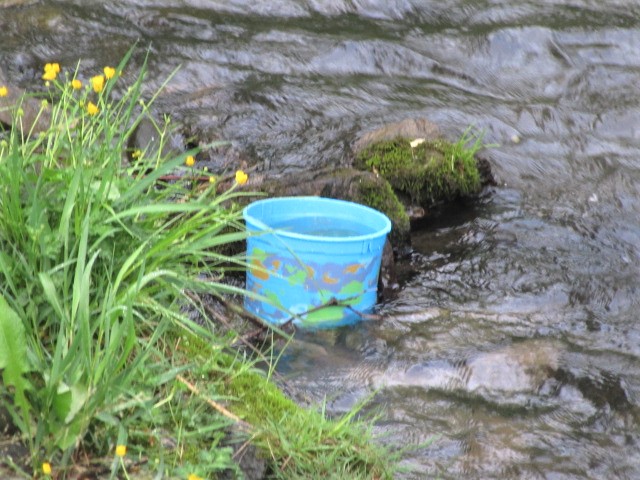
My purpose for being there, other than exercise, was to check on the stone heart and lock that had been left by the stream on February 12. They haven’t moved at all! I put today’s date on the photo for easy tracking.

Wordless Wednesday

Wordless Wednesday usually means a photo replaces words. The wordlessness today took place on our street. By tacit agreement, John and I do not talk until we have climbed the first hill. He has no breath to talk, and I am too busy huffing and puffing. I pulled on his sleeve to let him know a car was approaching behind us. I went to one side and he to the other. Looking back, we saw neighbor Bob grinning behind the steering wheel. He used both hands, motioning us to stay apart until he passed. I was enthusiastically waving him on, all of us laughing. As we moved back together, we saw Logan’s hand waving through the back window. It was just this year that we started the BIG WAVE when Logan is going to school. We flail both our arms wildly until he is out of sight to give him a good sendoff for the day. Silly? Oh, my! Yes! But it is harmless fun.

England 40 Years Ago — March 1, 1982

I heard a truck, a light tap of a horn, and went to look out the front window as a slip of paper came through the letter box. It was an emergency notice from the water company that water was being shut off immediately so that emergency repairs could be carried out. I ran to fill up some big pots while Kate went with the notice next door. A minute later Jennifer appeared in her apron wondering what it was all about. I thought it extremely considerate of the company to warn us. However, we never noticed any interruption of service! ?????

John and I took our first day trip without the girls, postponed from a fortnight ago when we spotted Kate’s chicken pox. We poked around Rochester in Kent, seeing the old cathedral and castle. For the second time we’ve seen organ pipes painted, though these were more uniform than the ones in Gloucester. I found a silver and ebony stick locked in a case that was shaped like a shepherd’s crook, but it had an odd extra piece sticking out. I wish I could have seen it better because it might have been a device for blowing out tall candles. Armin, a college friend, told us they use a blower in Germany – air blown into the tube and aimed at the flame.

The ruins of the castle are still impressive. People are allowed to climb the five or six stories on the old twisting stairs, and all the openings of windows are fenced in. What a marvelous view of the city from way up in the air!

Rochester Castle

It was good to speak to Harold, Aunt Kay, and Howard on the phone for a few minutes. For those of you who don’t know, Harold is John’s cousin who was getting married on Feb. 27.

We set out for Cardiff, Wales, in rain hoping the weather would change for the better. It did – we could see the moon and stars much of the way, but that was the last we saw of the sky for the whole trip.

Cardiff Castle, with a few Roman walls and additions from every century thereafter, is in the center of the city. We climbed up the steep hill to the round keep. The children were fascinated by all the peacocks, so John and I were left to concentrate on the history of the place.

Cardiff Castle
Cardiff Keep

Cardiff is noted for shopping arcades, so we dutifully walked through several. We discovered one of the crafts of this area – hand-carved lovespoons. We think a man is supposed to carve one for his sweetheart, but the stores help out those with five thumbs.

Outside Cardiff is a folk museum laid out like a little village showing Wales of the past. Cheerful log fires were burning in every house. One friendly guide invited the children to sit close to the fire, actually inside the huge chimney, and to look up to the way it narrowed at the top. We tried a picture upstairs in a thatched cottage, trying to get the lovely underside of the thatch. Even in fairly primitive houses there were grandfather clocks. We liked the beds in the more comfortable houses – a mattress completely enclosed in a large wooden box. Must have been cozy. One guide pointed to what we thought was a stone floor. “No,” he said, “It’s made of earth, manure, and blood.” That accounted for its red colour.

Underside of thatched roof
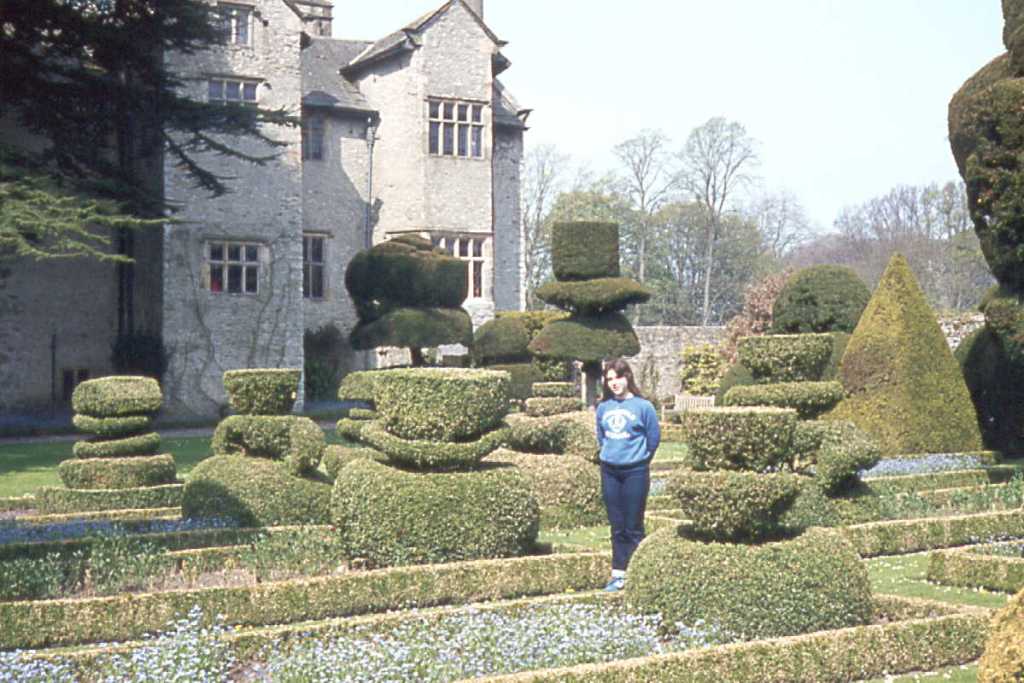
Hedge at folk museum

We drove into the Welsh mountains, but the fog was so thick we could only see the side of the road. My impression of Wales is of green and grey – lush green grass, grey sky, grey buildings, grey earth. Coal mining is the main industry in the southern part. It is a poor land, though the miners are better paid now than they used to be. We saw Aberfan. Do you remember the tragedy of 10 – 15 years ago when a slag heap buried a school, killing most of the students? We saw no scar on the landscape; grass must have covered it now.

We all laughed the next day, even Lisa. We said, “Can’t you just imagine coming into your hotel room after a pleasant evening, relaxing in bed, and then hearing someone in the thin-walled bath next to you violently vomiting? Poor Lisa had been asleep, woke in time to aim the first bit in her own bed and got the rest into the toilet. John helped her in the bathroom as I stripped off her sheets and pillowcases before the mess soaked in. Kate calmly slept through it, but $ woke up, peered over the side of his cot, and mischievously imitated the (w)retched sound.

John $ had had a coke the night of Lisa’s sickness and was wide awake after all the excitement. His father fell asleep, woke with a start when $ made a sound, leapt out of bed, grabbed the boy, ran with him into the bathroom and thrust his head in the toilet, thinking he was about to throw up. Then he stopped to look at $ – white as a sheet, shaking, and a heartbeat going a mile a minute. The poor mite was scared stiff! He hadn’t a clue as to what was happening. We must have sat holding him for an hour after that traumatic experience; he would lie back not moving a muscle, but his eyes were sprung wide open. Never did get sick!

Parts of the Welsh mountains reminded us of the moors – no trees, sparse grass, marshy land, wild ponies and sheep grazing. Across major roads are cattle grids to keep animals away from villages. The sheep had long tails, even the ones penned in and obviously belonging to someone. All other sheep we’ve seen have had their tails docked.

Sunday morning we inquired at the hotel about the time of the service in the cathedral, but no one knew. We often get to church on time, though we never know if the service is at 9, 9:30, 10, or 11. There seems to be no set custom. This time we missed; the last hymn of a crowded communion service was being sung as we walked in at 10. We stood at the back until the processional ended, and a former headmaster of a school caught us to welcome us. He knew the history of the church thoroughly and had a knack of asking questions that would catch Kate’s interest. He showed her a picture in which a man appears to have six toes, a mouse carved in the underside of a kneeler, a squirrel in King David’s family tree, a stone carving of a pelican, and a peep hole from a side chapel to the altar of the lady chapel. He held us spellbound with the tale behind the six female angels and their placement in the church. Several times he made “witnessing” statements – if only all churches had such men alert on the front line!

The cathedral for Cardiff is called Llandaff Cathedral. The double “l” has a guttural sound, almost like “cl”.

On our way home, we went to Hereford to see the cathedral there. That church is very open; John spotted repairs in the marble floor where a choir screen once stood. In so many churches the screen obscures the altar and the whole front of the church.

Hereford Cathedral

We drove around Caerphilly castle, second in size only to Windsor, though it’s crumbling. We also saw the beautiful ruins of Tintern Abbey. The weather was against us most of the trip, but we had a good time. The hotel we stayed in two nights really has good ideas for family travel. We got a special rate for staying two nights at the weekend, and the price included breakfast for all and a three-course dinner for two adults. We paid one pound extra per night per child for the room and paid for their meals. They had a choice of things from a kiddie’s menu or anything from the regular menu at half price! It was not a costly holiday.

Caerphilly Castle
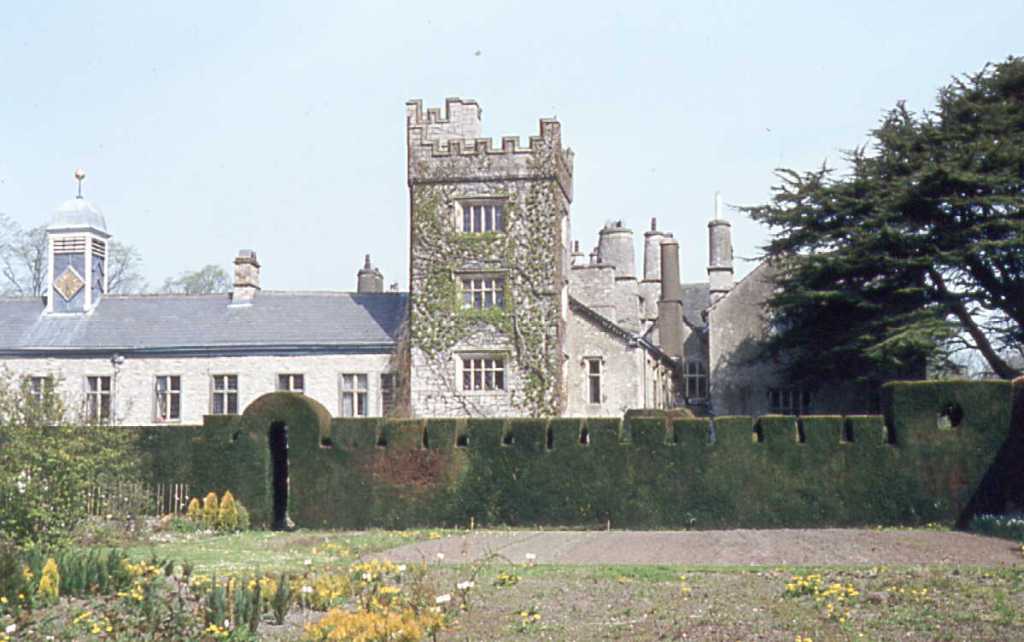
Tintern Abbey

Back at home, I was measuring milk for pancakes when movement from the back garden caught my eye. It was a fox! It had a pointed muzzle, dainty legs, red fur, and a paint brush tail dipped in white paint. Beautiful.

England 40 Years Ago — February 23, 1982, Part 2

We found the town of Delft with no problem, but would have missed the porcelain factory without Lisa’s sharp eyes. Most prices on the items for sale were not visible as we walked through the showrooms. There were pictures showing how the greenware was made, and two live artists in the middle of a room painting the blue designs by hand. Actually, the paint appears black and turns blue after firing. The artists did have a rough charcoal-looking pattern on the plates and a finished plate propped in front of them to which they constantly referred. After seeing that, we understood why each piece is so expensive. A guidebook explained the trademark – a pot with a line over it, a stylized letter “f” and the word “Delft” are on all the authentic pieces.

We had been along lonely stretches at noon and couldn’t find a cafe. At some teeny weeny town we ducked in a tiny grocery. There were as many fresh fruits as in Co-op and a cheese section as big as the old Cheese Shed in Stony Brook. I’d wager we were the first Americans ever to set foot inside there; the three people were as helpful as could be without knowing much English at all.

We had our picnic in the car in a deserted parking lot beside a school, out for vacation. We never saw another person in the whole town.

Several places we saw young trees where you’d not expect trees – on a narrow street with hardly any pavement (English for sidewalk) and outside that school where we ate our lunch. The trees were being trained to be flat! Their branches were tied to flat triangular frames, and their trunks trussed up with wrappings. I presume they wouldn’t look so bereft with a few leaves on them.

Kate with a flat tree

$ is good at putting on his own coat if it is laid on the floor facing the right direction. He thinks he knows how to do it all by himself, so usually gets it right half the time. The other times his hood covers his bum (English for that part of the anatomy which is used for sitting). In the car he put on his coat and played with Lisa’s swim gear. The picture he made with his coat upside down was so cute, but with the addition of a girl’s plain white swim cap worn slightly askew on the head, the effect was side-splitting. [I don’t have a photo of the side-splitter, but the one here shows $ hanging on the steering wheel with his coat upside down.]

We noticed that parents often hold a hand of their child or a handlebar of their bike as they roll along. John claims it’s to hold the mother up! Special bike lanes are everywhere, city and country alike. Hardly five minutes could go by without having a bike in sight.

We saw two Dutch ladies coming from a supermarket dressed in a national costume. They had voluminous black skirts, a small print apron, colourful shawls, and white lace caps. Their caps fit close to the head, though we understand in the area of Volendam and Marken caps have gull-like wings. The ladies we saw also had a hair-do to go with their dress, a big roll of hair atop their faces. We wondered how they kept it up; it looked as if there was a giant sausage roller inside. [I was trying to take the picture where they could not see me.]

We were tired and hungry by the time we arrived in Ghent, so we were thankful to get a hotel room in our favorite chain. It was the last room available and had one drawback – no curtain over the hugest picture window I’ve ever seen in a hotel. We were just careful to dress in the bathroom and scurried around in darkness like mice.

We heard the cock crow before dawn, thanks to $. He was tired of bed and climbed out. Kate and I took him to the lovely playground full of wooden equipment not far from our room, before 7:00 am! He loved the slide with a house at the top and had no trouble figuring out what to do. I was hoping the funny frozen things I could barely see were clods of grass instead of what I feared. As it became brighter, we found that it was just grass. Whew! We were certainly ready for a warm breakfast after our predawn romp.

Dutch houses that I liked:

We pushed on to Calais, got an earlier boat than we’d booked, and got home at the time we should have been boarding on the other side.

After some signs I saw today, I’m simply not going to worry about all my spelling mistakes. Somewhere in the world there must be someone spelling words like I do. The sign pointing to the capital of France said, “Parijs.” Truly! We saw it several times in Belgium.

England 40 Years Ago — February 23, 1982, Part 1

What an exciting meal we had! Lisa was kindly helping serve the plates with spaghetti and a juicy dark red meat and tomato sauce. We always serve $’s plate first and often put it in the freezer to cool a few minutes. She did that, took two plates over to our table, and when serving her father, discovered the momentum peculiar to moist spaghetti on a moist plate. It quietly slithered over the side of the plate, onto the table, and down in a red splat on the green carpet. John nimbly leapt aside, ran for a spatula to rake it up, and began cleaning as I opened the freezer door for $’s plate. Splat! The plate evidently slid to rest against the door when Lisa closed it and naturally exploded onto the floor. Kate shared with John, I shared with $, and we ate happily ever after. The moral is: the family that messes together mucks together.

Did you know that English people don’t have odds and ends? It isn’t that they are neater than we, but they have “bits and pieces”. They also have “odds and sods”, various things of little importance.

Also, though I’ve read of chain stores here, it can just as well be “multiple stores”. I guess that’s all right unless they abbreviate it to MS. Paula (friend I met as a cashier at the supermarket) had never heard of multiple stores. Perhaps it’s something written, not spoken, or it comes from a different section of the country.

The butcher said, “here I am standing like a lemon.” These things are easier said than explained! Roughly it means you’re in a hurry, but momentarily pause because you can’t think what to do next.

We left for the Netherlands Friday morning and returned today, Tuesday. Windmills are not dead! We must have seen at least 10 on the drive up to Amsterdam, one of which had sails and was actually working. This was an exciting drive for $ who recognizes and calls by name trains, tracks, water, windmills, cows, sheep, horses, boats, and trucks.

I knew this country was rich in canals, but I had no idea it was branded by grids of ditches. Open fields beside the highway had small ditches (less than one foot wide) every 50 – 75 feet and three-foot wide waterways after every three or four small ditches.

Our luxurious hotel overlooked the junction of five canals. There seems to be more traffic in waterfowl than boats in the winter.

Our hotel
View from our hotel

Our first morning in Amsterdam began like no other – John called an American in London as arranged and took a new job! He’d been interviewed on Thursday, and there were a few questions on both sides. He is supposed to start work May 1, having a chance to be with us when the girls have a month off from school. The company is downtown in Manhattan. So, we’re all headed back to New York eventually, though the children and I may stay in England for school and housing reasons for a while longer.

Amsterdam is the diamond center of the world. We walked to the van Moppes diamond shop from our hotel. To cut a one-carat diamond takes eight hours! Then it must be shaped, the facets cut, and the polishing done. We learned that a great percentage is lost in cutting, but that all dust is saved and used, mixed with olive oil, for cutting and polishing. Only diamonds are strong enough to cut diamonds.

Our little Japanese guide spoke fractured English, but much of what she talked about was on signs. She and I talked quite a while after the tour, and she said though she’d lived in Holland for seven years, her Dutch was atrocious. She claimed that people who speak English will try their best to understand, but the Dutch people insist you speak their language perfectly. If she mispronounces a Dutch word, she will be told bluntly that she is not understood.

Dutch people, unlike the English, eat publicly all the time. Restaurants are open earlier than in England, and informal snack bars are everywhere. There are pastry shops, cafes, burger places, pizzarias, doughnut stores, and coffee shops galore. Not only are the eateries there, but there are always people inside snacking.

We rode the tram into the downtown area and took the hour-long canal tour of the city. When the recorder tape broke, the man in charge announced things in Dutch, English and German, and a passenger volunteered to translate to French. We were impressed with their linguistics. We found that Dutch children are required to study those four languages in school.

Below are photos of a bridge over a canal, a wide canal, Central Station, interesting facade of a house, and a tiny white building that is only one window wide.

The canals do not stink, being kept flushed by the tide. Only one river is a natural waterway; all the canals are man-made. I used to feel sorry for these people having to cope with water, and now I find it is by choice in Amsterdam!

John spotted the highlight of our walking tour – movers using block and tackle from a hook at the top of a house to lift crates through the wide upper window. A majority of the buildings seem to have these hooks on beams.

Three windows removed for moving furniture in

Most canals have one-way streets on both sides, and cars are parked by the squeeze method. Wherever you think a car wouldn’t fit, there is a car. A pedestrian’s life is in almost as much danger from bicycles as cars – the bikes WHIZ where the cars only speed.

We saw the grey stone royal palace from the outside and Rembrandt’s house from the inside. R’s house is full of his etchings and has a good display showing how etchings were made. A copper plate is coated with an acid-proof layer, that layer is scratched away by the artist to expose the metal, and an acid bath eats into the exposed lines. The plate is cleaned, inked, and then printed on damp paper.

Royal palace
Rembrandt’s house

We went in one large church that made us appreciate more worshipful attitudes elsewhere. Chairs were faced toward two organs rather than the altar, social action signs were hanging from the rafters, flower prints were sold from stalls, and there were vending machines and tables set up for coffee drinkers! We were impressed with the HUGE carved wooden canopy over the pulpit. It had angels, religious figures, windows with people inside, and little people hanging over balconies. Our overall impression of church life in Holland was that few people bother. One lovely old church had been turned into a water sport place, and many of its windows were broken. Sad.

We’d read that the Dutch do not guard their privacy as the English do. On a long rambling walk after dark, we found that we could easily see into living rooms. On a cold clear night, they all looked cozy and warm.

On a clear day we drove north of Amsterdam to Volendam, built on the water. Two rows of houses were built on top of the dyke – tiny houses that we could see right through on either side of a one-way lane. The rest of the town was set down below sea level behind the dyke.

Edam, where the cheese of that name originated, was a small community built around a canal. We also poked around Hoorne before driving over the biggest dyke – the one closing off what used to be the Zeiderzee. We made a big circle around that water, driving on roads where the land on both sides was newly reclaimed and not yet productive. It was so empty – empty of plants, animals, and houses. Swinging toward Amsterdam, we were almost relieved to be among living things again.

Hoorne Museum
Family on largest dike we saw

In each country travelers like to spot local colour. Many times national quirks are hidden or minimized in larger hotels. Most places we’ve been serve croissants for breakfast from the French custom, bacon and eggs from the English, porridge from the Scots, and cold cereals for Americans. In addition to the above, in Amsterdam there were pots and pots of sprinkles – milk chocolate, dark chocolate, vari-coloured, white, white and pink mixed. I couldn’t resist asking what they were used for. The waitress in national costume replied, “The Dutch have a peculiar habit of sprinkling these things on buttered bread.” Later that day I saw shelves full of sprinkles in a tiny grocery store. Each package had a picture of a thick slice of bread with these sprinkles being poured on top of the butter.

Logan, a Breath of Fresh Air

Neighbor Logan (11) had not come over to visit us for a long time, probably because he was very busy with school and sports. I let him in, and he spotted John at the dining room table. He made a beeline to John, hesitated a moment and sat down opposite him. He knows he is always welcome to share a meal with us, but we had finished eating. When John asked how school was, Logan responded with something he knew would please John. He mentioned that they have been studying Roman emperors in history. There ensued a discussion of what period was involved, and John brought a book to the table with appropriate photos to show him. I was impressed that Logan knew where this fit into the historical time-line.

We think Logan’s sense of appropriate behavior is far above average. He waited until John paused to ask what he came over for. “Could we play checkers?”

I have a standard ritual of hiding a granola bar for Logan to find. I suggested he find that while John set up the game. It’s difficult for me to find a hiding place that is challenging. Recently he asked that I make it a little harder! When he looked all around the room several times, I told him to look waist high. Bingo! He found it.

As the fellows played, I took a photo to show the concentration. They played three games until it was almost time for Logan to go home.

I was playing the day’s game of Set on my phone and showed him my time, which I think was over six minutes. I handed the phone to him, and he finished the same game in one minute and a few seconds. I am always impressed at how quickly he and David can solve those things.

As Logan put on his shoes, he thanked us several times. His manners are superb, much better than those of many adults. Every time I notice, I silently applaud Shawn and Bob for their excellent job in training him. These skills have become natural to him and will help him in everything he does for the rest of his life.